




Four years ago, as economic activity was halted by the pandemic, the importance of accessible and affordable child care became painfully obvious. This paved the way for a national childcare program announced in 2021, or what is commonly referred to as the $10-a-day program.
Though such a program comes with a variety of policy goals, one was to increase the labour force participation of women. As Deputy Prime Minister Chrystia Freeland put it, “Access to child care is as much an economic policy as it is a social policy…it ensures that parents – especially mothers – can work.”
On this front, it appears to be meeting its policy objective. Women with young children are more likely to be working now than they were before the pandemic—78.6% versus 76.4% (while women with older children and those without children saw little change). Also important, this increase is slightly higher than in Quebec which, although it did receive additional federal funding, already had a similar childcare program in place.
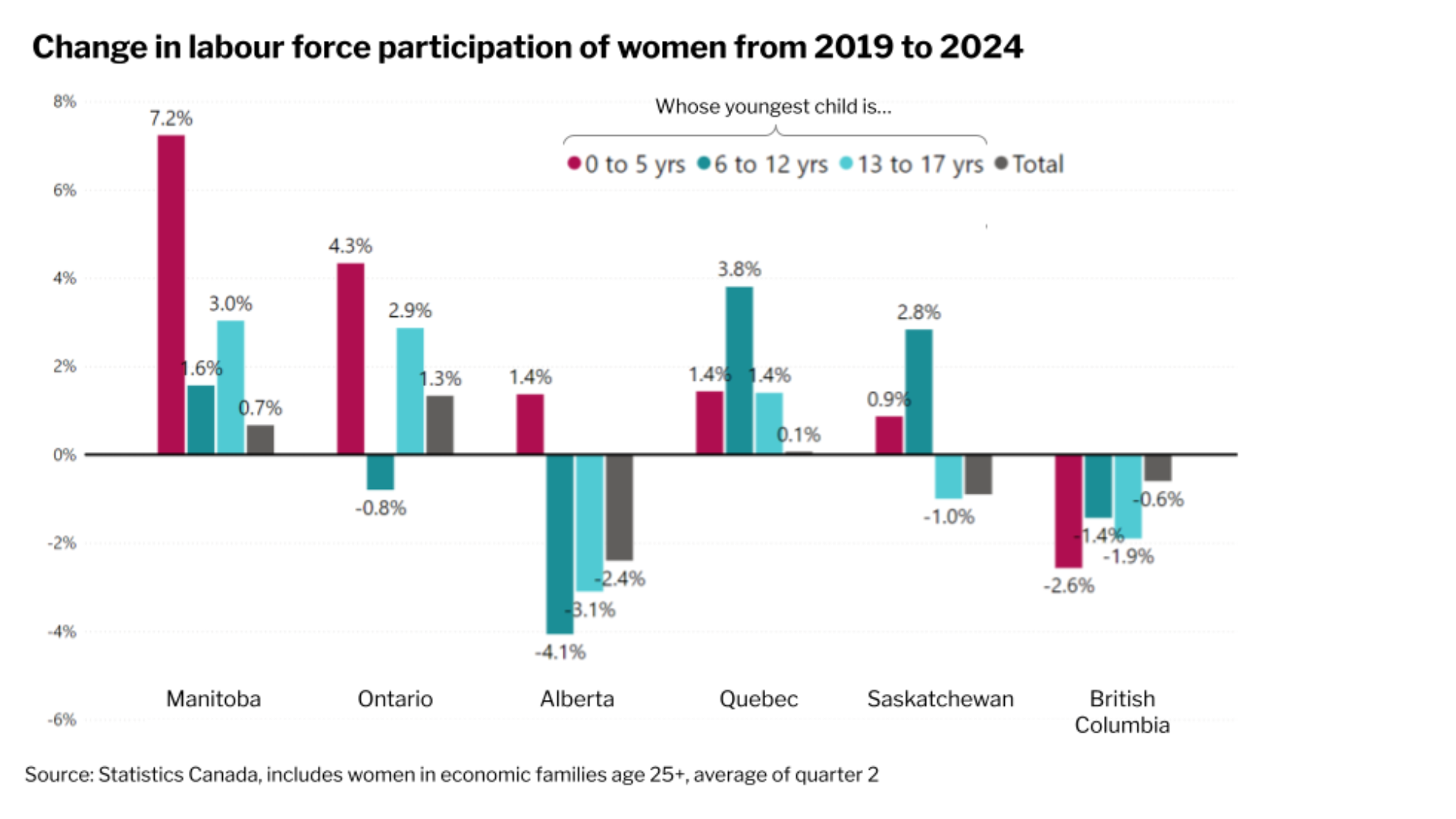
But some provinces have shown more success than others.
Manitoba, Ontario, and Alberta have all seen a disproportionate increase in the participation of women with young children relative to other comparable groups. This difference is most noticeable in Manitoba where participation increased by an astounding 7% points (versus just 1% among women overall) and in Alberta where women with young children were the only group that did not see a decline.
Meanwhile, in Saskatchewan and British Columbia, the program hasn’t proven its success. In the former, women with older children were more likely to join the workforce while in BC women with young children were most likely to leave.
As far as what could be driving these results, one consideration is program capacity. Cheaper child care means more families can afford it, but stories of waitlists suggest program expansion has been slow and could be worse in some cities than others.
In fact, it’s possible that even among those provinces that have seen a notable increase, more women would have joined the labour force if not for certain daycares or neighborhoods being full.
Another consideration is the data itself. Though the Labour Force Survey connects with over 50,000 households each month, response rates have been in decline and results from small subsets of the larger survey (like, say, women with young children in a given province) will be less precise.
Monitoring results over time will be important, as will gaining a better understanding of the any barriers that persist to the accessible childcare system Canada set out to build.
Have an indicator you want us to look into? Email us at media@businesscouncilab.com.
You can also read this article on The Hub, here: https://thehub.ca/2024/07/16/alicia-planincic-canadas-childcare-program-is-increasing-female-labour-participation-but-not-in-every-province/