




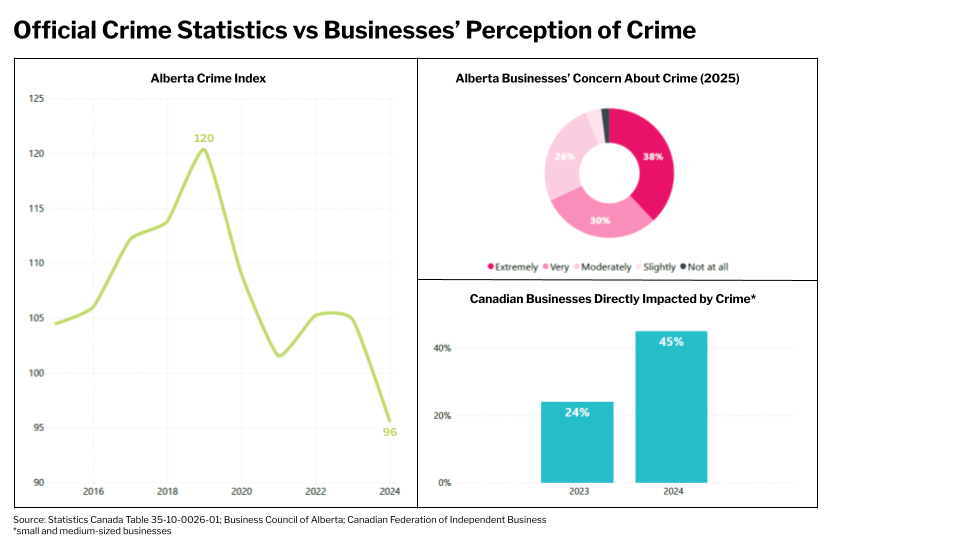
According to official data, violent and non-violent crime declined across the country and in most provinces from 2023 to 2024. Although it has trended up slightly over the last decade, it’s still lower than it was at any point prior to 2010. But that picture doesn’t match what businesses and communities are experiencing.
In the Business Council of Alberta’s most recent report, Municipal Matters: Business Priorities for Alberta’s Local Governments, we surveyed our members to learn what they see as the most pressing challenges facing local municipalities. Crime and disorder easily topped the list, with 94% identifying it as a problem and one third saying they were “extremely concerned” about it. They worry about the safety of their employees, rising costs, and their ability to recruit people and attract capital.
It’s not just Alberta businesses that are concerned about crime and disorder. Across Canada, 6 in 10 small and medium-sized businesses say crime in their community has worsened over the last year and just 1% say it’s improved. From 2023 to 2024, the share of businesses directly impacted by crime almost doubled. Whether it’s shoplifting from the local store or copper wire theft from construction sites, few businesses are unaffected: a large majority report vandalism, break-ins, or theft, and one-third say their staff or customers have been harassed.
The costs add up quickly. In retail alone, businesses lost around $9 billion to theft in 2024. Small businesses report spending about $5,000 each on crime-related expenses, while about two-thirds have invested in new measures like cameras, tracking devices, and security guards.
These may be necessary actions given the reality of the situation, but they’re also a drag on productivity and efficiency. Companies would much rather spend their time and money running their operations, but they don’t see local governments doing their part; only 14% believe the taxes they pay lead to improvements in community safety.
And those are just the direct costs. There are a host of indirect ones as well: disrupted operations, lost foot traffic, and staff reluctant to work in certain industries and locations. Some businesses are actively considering relocating, while others avoid investing in locations with high or rising crime altogether. This is bad news for the long-term health of our cities and towns; when businesses leave, so do the people.
So, why the gap between official statistics and business perspectives?
The problem is that crimes only show up in the official data when they’re reported to the police. But the vast majority of businesses don’t always report incidents. They expect the process to take too long, see little chance of a meaningful police response, and, frankly, doubt it will make a difference. They also face a financial disincentive to reporting—82% don’t always file crime-related insurance claims, which require a police report, for fear of higher premiums down the road.
In other words, you can’t always trust the data. Closing the gap between crime statistics and public perception requires taking concrete steps to reduce crime itself. That means increasing police presence, addressing bail reform, ending “catch and release” arrests, collaborating with businesses and the community to address local safety concerns, and implementing a robust homelessness and addiction strategy.
Businesses are already bearing the cost of crime on their balance sheets, changing where and how they operate to limit its impact. That might not show up in the official data, but the evidence is everywhere else.
Have an indicator you want us to look into? Email us at media@businesscouncilab.com.