

Budget 2025 marks an improvement, but missed the moment to generate true prosperity for Canadians.
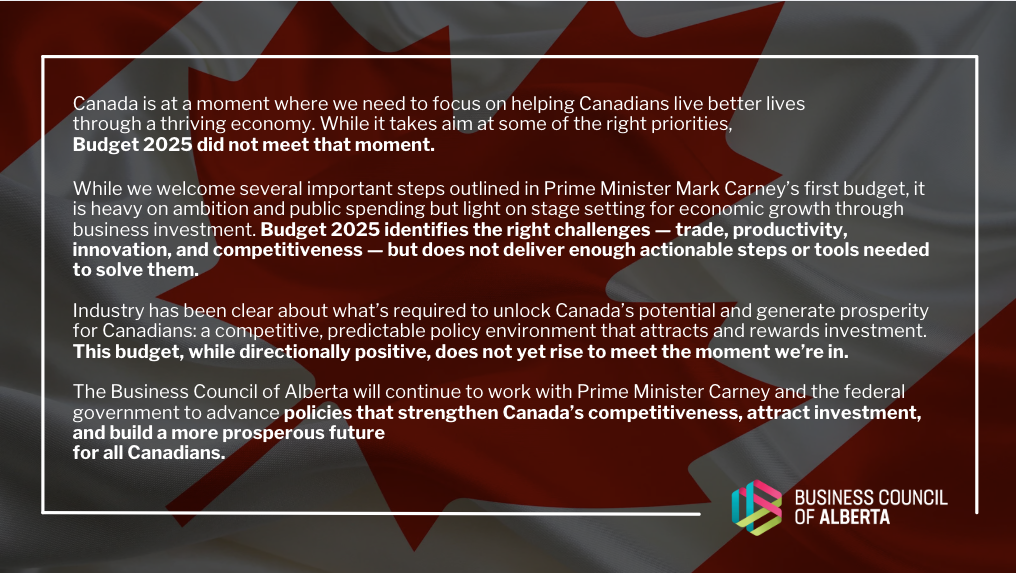
Canada is at a moment where we need to focus on helping Canadians live better lives through a thriving economy. While it takes aim at some of the right priorities, Budget 2025 did not meet that moment.
After more than a decade of stagnant business investment and quality of life, declining productivity, and flat economic performance, Canada needed a reset — one that would unleash billions of dollars of private sector investment through building, innovating, and creating jobs here at home. Instead, Budget 2025 leans too heavily on public spending and signals of intent, without the clear policies or structural reforms that would truly encourage businesses to invest and grow.
We welcome several important steps outlined in Prime Minister Mark Carney’s first budget:
- A renewed focus on trade and the infrastructure needed to access new global markets;
- Increased investment in defence, reinforcing Canada’s sovereignty and our role among global allies;
- A range of new and expanded tax incentives to address Canada’s lagging record on business investment in facilities, equipment, and technology;
- A review of greenwashing provisions that have unintentionally discouraged innovation and clean technology investment;
- Continued recognition of Canada’s potential as a global leader in critical minerals, energy, and emerging technologies like AI and quantum computing.
- The potential elimination of the oil and gas emissions cap, which would be a welcome signal for investor confidence in Canada’s energy future.
However, the budget falls short where it matters most — creating a truly competitive environment that attracts private capital and builds an economy based on private sector investment. It relies too much on public sector spending, and our initial assessment is that measures contained in the budget will not be enough to unlock private sector dollars at scale.
Budget 2025 does not provide the specificity and clarity businesses need to get projects built. Even with reforms under Bill C-5, Canada’s review and approval process remains too slow, uncertain, and cumbersome for all but a handful of favoured projects. The budget adds some additional funding for the new Major Projects Office, but until these larger issues are resolved, investments will continue to pass Canada by. The budget also misses the opportunity to address long-standing policy barriers — from the tanker ban to regulatory uncertainty and the Clean Electricity Regulations — that continue to constrain investment in natural resources, power, data centres, and other industries.
On taxation, the investment incentives described earlier are a step in the right direction, but Canada still needs comprehensive tax reform to compete globally and reward working and investment. The absence of a commitment to review our uncompetitive personal and corporate tax system remains a missed opportunity.
We are also concerned by the government’s loose fiscal guardrails. Large, sustained deficits risk crowding out private investment and divert more government revenue toward interest payments on the public debt, as opposed to priorities that enable Canadian prosperity. For all the borrowing required to fund this budget, it is unclear whether Canadians will see results that justify the cost.
Overall, Budget 2025 is heavy on ambition and public spending but light on stage setting for economic growth through business investment. It identifies the right challenges — trade, productivity, innovation, and competitiveness — but does not deliver enough actionable steps or tools needed to solve them.
Industry has been clear about what’s required to unlock Canada’s potential and generate prosperity for Canadians: a competitive, predictable policy environment that attracts and rewards investment. This budget, while directionally positive, does not yet rise to meet the moment we’re in.
The Business Council of Alberta will continue to work with Prime Minister Carney and the federal government to advance policies that strengthen Canada’s competitiveness, attract investment, and build a more prosperous future for all Canadians.