




It may not seem like it from the outside, but being a finance minister in Alberta is a tough job. All those oil and gas revenues might look like a godsend, but they leave provincial finances highly vulnerable to global energy markets and the vagaries of geopolitical turmoil.
As Alberta Premier Danielle Smith made clear in her recent address, this year will be especially challenging for Minister of Finance Nate Horner. A slowing global economy, signs of oil oversupply, and continued threats of tariffs and lost trade deals, all point to lower oil prices and, in turn, lower resource revenues for Alberta.
As a result, once Alberta’s 2026 Budget is released, much of the attention will be on how much non-renewable resource royalties are expected to decline compared to the current fiscal year and what that means for the province’s bottom line. The numbers involved — almost certainly in the billions of dollars — will be attention-grabbing. But on their own, they can be hard to interpret without context.
Three things in particular are worth keeping in mind:
First, resource royalties remain as important as ever to Alberta’s budget.
The province has diversified in terms of employment and income. But when it comes to public finances, Alberta still depends heavily on royalties from its oil and gas sector to balance the books.
Without resource revenues, Alberta would face a significant revenue gap. In recent years, resource royalties have generated a remarkable $20 billion annually or about one quarter of total provincial government revenues in a roughly $75 billion budget. The good news is, that share is well below historical peaks — royalties exceeded 50% of revenues in the early 1980s — but it’s also far above the 5 to 10% range seen in the late 2010s.
One reason royalties have increased in recent years is that many oil and gas projects have recently reached “post-payout” status. Because oil sands projects require significant up-front capital investment, the province collects royalties at a lower tier until the company has recovered its costs. At that point, a new, higher royalty tier kicks in.
While post-payout status means that the Alberta government collects more revenue at any given price of oil compared to before, reaching that level hasn’t eliminated fiscal concerns in the province. Higher revenues have also coincided with higher spending, a pattern seen repeatedly over the province’s history and, most recently, reinforced by rapid population growth. For example, the 2025 mid-year fiscal update expected a $6 billion deficit despite bringing in $15 billion in royalties from resources.
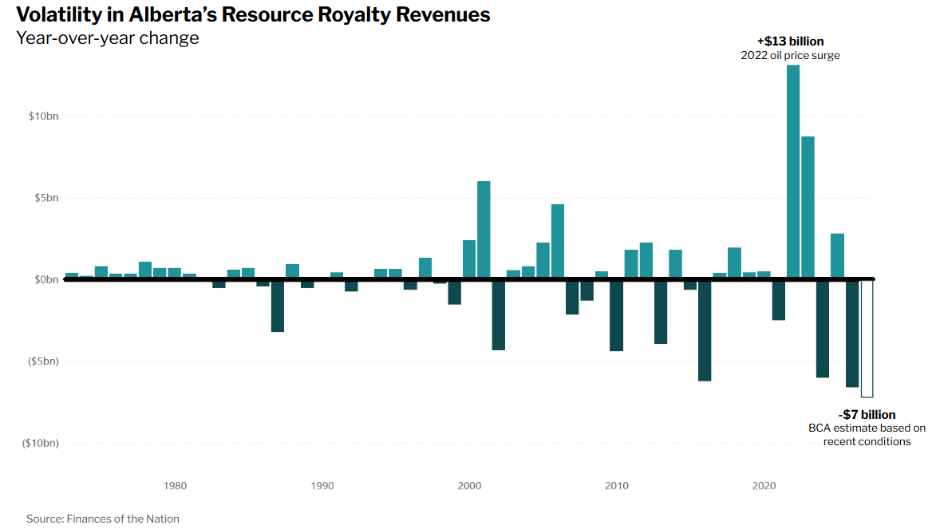
Second, resource royalties have become more, not less, volatile over time.
Small changes in the price of oil, or in the discount Canadian producers receive relative to U.S. benchmarks, have major implication for the provincial budget. A $1 US move in the wrong direction on either front translates into roughly a $750 million hit to provincial revenues. Meanwhile, a $3 US dip amounts to more than $2 billion.
Less well known is how much that sensitivity has increased. Just five years ago, the fiscal impact of a similar price change would have been less than half what it is today. And the swings Alberta has seen in resource royalty revenues in recent years dwarf those of the past. Since Budget 2020, non-renewable resource royalties have fluctuated by an average of roughly $6 billion from year to year — even after excluding the largest COVID-related outlier — compared with average swings of around $2 billion in the decade before that.
While volatility cuts both ways, the fact that resource royalties are both more volatile and more important makes fiscal planning extremely challenging.
Over the long term, the province aims to grow the Heritage Fund to $250 billion by 2050 to help stabilize its finances. Building up Alberta’s sovereign wealth fund is a good idea, but it’s unlikely to solve the revenue volatility problem on its own. Revenue from a $250 billion fund would likely only cover roughly 5 to 10% of what could be a $200-billion provincial budget by 2050.
Finally, increased market access is supporting stronger revenue.
As Premier Smith noted, WTI prices have recently been in the low $60s, and forecasts expect them to remain low this year, well below the $71 US per barrel average assumed in last year’s budget for 2026.
That said, it’s not all bad news. Improved access to global markets has helped offset the pressure.
The Trans Mountain Expansion (TMX), which came online in mid-2024, roughly tripled export capacity to the coast, and its impact has been significant. By expanding access to international buyers, TMX has allowed Canadian producers to receive higher prices for their oil. That’s reflected in a narrower discount on Canadian heavy crude of around $11 US per barrel, compared with earlier expectations of roughly $17 US. Improved market access is estimated to have generated around $5 billion in additional provincial revenues this fiscal year.
All this to say, as Minister Horner finalizes Budget 2026, it’s shaping up to be another challenging year for finances in Alberta.
Have an idea for our next EconMinute? Email us at media@businesscouncilab.com.