




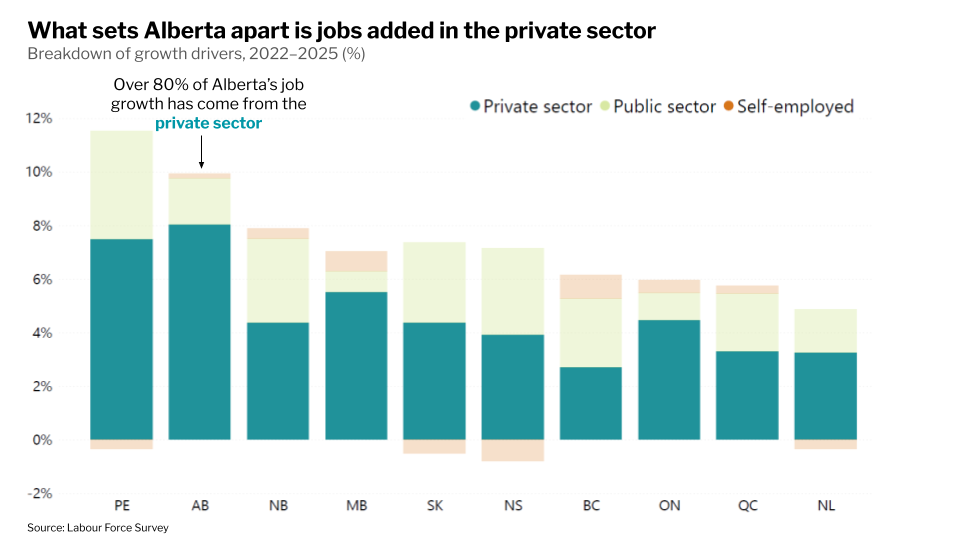
Alberta has led the country in job growth in recent years. From 2022 to 2025, employment increased nearly 10%, according to the Labour Force Survey (LFS), more than any other large province and well above the national average of 6.5%. With growth outpacing the rest of the country, it’s worth taking a closer look at what’s driving it and how Alberta’s labour market is changing.

In addition to the overall pace of growth, strong gains in private sector employment set Alberta apart. No other province saw more private sector job growth than Alberta over that period — a difference that is especially stark relative to provinces like BC, Quebec, and Saskatchewan where an expanding public service masked broader labour market weakness.
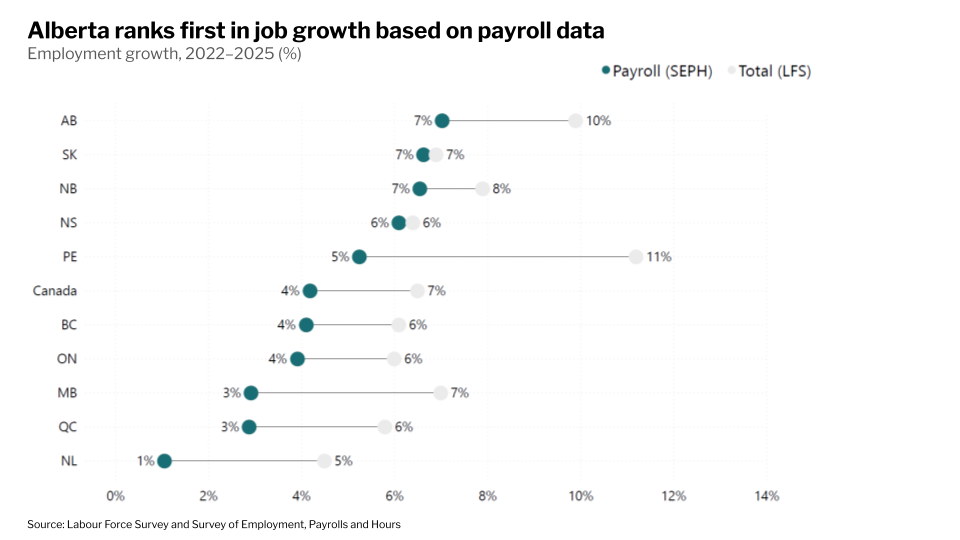
But determining which industries are driving job gains is trickier. The LFS depends on a relatively small sample of households, meaning swings across industries can reflect real changes or just survey noise. More worrisome, even topline LFS estimates may be overstated, for both Alberta and Canada, given challenges in estimating population growth.
This is where payroll employment data helps. Rather than relying on a household survey, the Survey of Employment, Payrolls and Hours (SEPH) draws primarily on employers’ payroll records. While it excludes the self-employed, it covers the vast majority of employees and provides a more precise, stable picture of employment by industry.
According to SEPH, job growth in Alberta, and across Canada, was not nearly as strong as the LFS suggests, especially in provinces with faster population growth. Even so, Alberta was the clear leader. From 2022 to 2025, payroll employment grew 7% in Alberta compared with 4% nationally.
But where does Alberta stand out relative to the rest of Canada?
The short answer is almost everywhere. Alberta saw faster employment growth than the national average in 14 of the 18 categories we assessed. That broad strength reflects rapid population growth. Since 2022, Alberta’s population has increased by around 11%, or over half a million people, making it the fastest-growing province in the country. As the population has expanded, so too has demand for housing, financial services, entertainment, and the workers needed to support them.
Still, a few areas are especially notable. These are the industries that both added a large number of jobs and saw the strongest growth relative to the national average.
Health care is one of the clearest examples. Employment in the sector increased by about 15% from 2022 to 2025, well above the national average of 9%, with gains across hospitals, nursing and residential care, and outpatient services such as clinics, testing centres, and home care.
It may also be an unexpected contributor to Alberta’s strong private sector job growth. While often viewed as part of the public sector, many health services are publicly funded but privately delivered. The LFS, which distinguishes between public and private employment, suggests a large share of Alberta’s recent health care gains fall into this category.
Payroll data adds some context. While it doesn’t distinguish between public and private employment, the pattern of growth suggests both are playing an important role. Hospitals, which are generally in the public sector, account for the largest share of new jobs and grew at roughly double the national average. But growth has also been especially strong in home health care services and practitioner offices, both of which are often privately delivered.

Construction has also played a major role in Alberta’s employment growth. Employment in the sector has grown about 10% since 2022, roughly double the national average, driven largely by residential building. Growth is even stronger since 2021, with an 18% increase since the start of the housing surge. But it’s not just a housing story. Since 2022, jobs tied to large-scale industrial projects — including oil and gas facilities, mining sites, and pipelines — have increased by 59%.
Meanwhile, one of the most notable examples of where Alberta stands out is in one of its fastest-growing, albeit smaller, sectors: childcare. Employment in child day-care services has increased by a remarkable 46%, the fastest growth in the country and well above the national average of 25%. That amounts to more than 7,000 new jobs in a relatively small industry over just three years.
This growth reflects both rising demand from more young families and improved affordability. As a result of the childcare agreement between Alberta and Canada, fees dropped to $15-a-day on average, saving families around $13,700 per child, the largest improvement in affordability in the country.
While much of Alberta’s growth is concentrated in domestically driven sectors like health care, childcare, and residential construction, there are also signs of broader strength. Strong gains in industrial construction, tied to energy and major projects, along with growth in manufacturing and business support services, suggest businesses are expanding and investment is picking up. Manufacturing employment, for instance, is up about 6% (roughly 7,000 jobs) even as it has been flat nationally. The province has also seen outsized growth in business support services such as payroll and administrative services.
What’s also notable is what’s not driving Alberta’s outsized job growth. Despite strong gains in oil and gas production and exports, employment in that sector has remained relatively flat as productivity improves. Likewise, while the number of school-aged children has grown at more than double the national average, employment in elementary and secondary education has increased only in line with the rest of the country. That may change, however, as the province aims to hire more teachers and educational assistants over the next three years.
Overall, Alberta’s robust job growth since 2022 reflects both strong local demand and shifting labour needs, with gains concentrated in service industries and the private sector, some of which is tied to public funding. At the same time, growth tied to investment and business activity shouldn’t be overlooked. This suggests Alberta’s outsized performance reflects not only population and demographic pressures, but also broader economic strength.
Have an idea for our next EconMinute? Email us at media@businesscouncilab.com.