




The closure of the Strait of Hormuz has been a harsh reminder to governments that when energy prices rise, affordability quickly takes priority over decarbonization and other policy goals.
Canada has already shown that.
Recently, Prime Minister Carney cut the federal fuel tax on gas and diesel through September, after having already cut the consumer carbon tax last year to help Canadians save money at the pump.
Governments around the world are making similar moves, cushioning the impact of high oil prices on consumers while looking for ways to secure energy supply long-term. Many have cut fuel taxes. Others have gone further, capping prices and restricting exports. And in the most import-dependent markets, running out of key fuels is a growing concern.
But unlike its peers, Ottawa is increasing pressure on the production side.
It continues to ratchet up the industrial carbon price, raising the cost of emissions. The federal benchmark, which anchors provincial carbon pricing systems, is set to climb significantly through 2030. Meanwhile, Alberta, which has long operated its own system, could increase its effective carbon price to $130 per tonne as part of ongoing negotiations with the federal government to implement the Canada-Alberta MOU. That’s a steep increase from today’s market prices of around $20 to $40.
Because Canada is part of a vast global energy market, higher costs for Canadian producers are unlikely to lead to noticeable increases at the pump here at home. But they will make it more expensive to extract our own oil.
Therein lies the challenge when it comes to carbon pricing. If Canadian policy drives up production costs, the industry’s competitiveness will ultimately depend on whether international buyers are willing to pay a premium for cleaner fuel. Today, there is no global market for low-emissions oil and therefore no premium to be paid for such barrels.
The federal government, however, believes that will change.
In a recent discussion paper on carbon markets, the government argues that strong industrial carbon pricing will enhance, not inhibit, Canada’s future competitiveness, supporting economic growth and positioning Canadian energy to capture global market share. Reducing the oil and gas industry’s emissions intensity, it contends, is necessary to remain competitive.
The Strait of Hormuz is a reminder of what happens when push comes to shove; affordability wins over emissions intensity. Governments around the world are focused on securing affordable supply. Canadians, whose internet searches for gas prices have spiked, are no different.
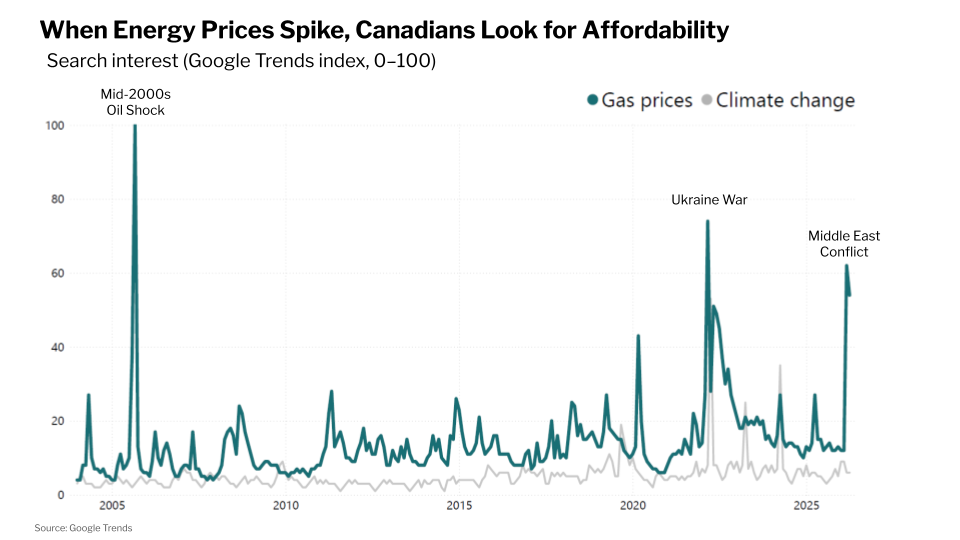
If global markets continue to prioritize cost and supply, while Canada goes all in on carbon pricing, it will lose market share to lower-cost alternatives, shifting emissions to other countries while gutting the Canadian economy — the very problem of carbon leakage government is trying to avoid.
That could change if other governments imposed similar carbon pricing requirements on their producers or on the imports they bring in.
But policy forces that would twist the invisible hand simply aren’t there. The EU, the only other region with a carbon pricing system of Canada’s scale, is now looking to relax that system to support energy supply and affordability. Meanwhile, a federal carbon tax or trading system in other major oil-producing countries, like the US or OPEC nations, remains extremely unlikely.
It’s not that carbon pricing wouldn’t work.
Economists have long argued it is the most cost-effective way to reduce emissions. Alberta’s oil and gas sector, which has been under carbon pricing for nearly two decades and reached an emissions peak in 2014 despite production growth, is a shining example.
The challenge is that consumers don’t want to pay for it. When asked about emissions-reduction policies, consumers tend to support whatever they believe will cost them least.
Reducing global emissions matters. But consumers’ willingness to pay for cleaner, costlier fuel is limited. Government policy can push in that direction, but as recent events have shown, it can quickly bend when affordability concerns start showing up in the polls.
Have an idea for our next EconMinute? Email us at media@businesscouncilab.com.