




The formal review of CUSMA begins in just a few weeks. While the federal government is pushing to extend the current agreement for another 16 years, a clean and tidy extension is wildly unlikely. Negotiations are expected to extend well past July, tariffs are set to remain, and an annual renewal, where businesses remain on pins and needles from one year to the next, seems very likely.
That makes trade diversification especially important in Alberta, which is more dependent on the U.S. market than any other province. Roughly one in seven jobs in the province depend on U.S. demand, the highest share of any province in Canada.
To date, the province has gotten off largely scot-free. Oil and gas not only dominate exports to the U.S., but they continue to flow tariff-free, giving Alberta the lowest effective U.S. tariff rate of any large province at less than 1%. As a result, concerns about tariff impacts have eased in Alberta while the effects continue to be felt in harder-hit parts of the country.
That relative comfort shouldn’t breed complacency, however. For one, it’s unclear whether oil and gas will remain tariff-free through the upcoming review. Approximately 93% of the value of the province’s oil and gas exports goes south of the border, and while the U.S. has so far recognized the importance of those imports, it’s also shown a willingness to harm its own consumers and economy. An across-the-board tariff without a carveout for oil and gas remains a real risk.
But there’s also a second reason: the province’s reliance on the U.S. market extends well beyond oil and gas[1]. Even after excluding those products, the U.S. still accounts for well over half of Alberta’s total exports and far more than any other market.
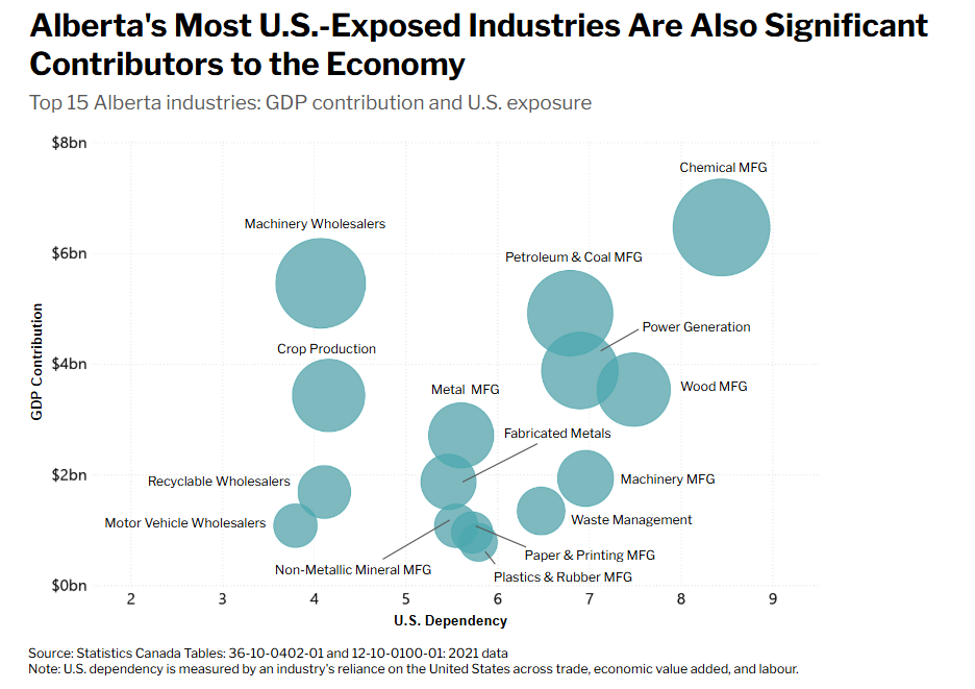
Alberta’s reliance on the U.S. isn’t confined to a handful of industries either. Of the 37 industries assessed, 34 send over half of their exports to the U.S.
The bigger the industry, the more it tends to rely on the U.S. market. Chemical manufacturing and machinery manufacturing, Alberta’s largest export industries outside of oil and gas, send well over 70% of their exports to the U.S. Likewise, other valuable export industries like forestry, power generation, and agri-food all rely heavily on American customers. Generally, the export industries that create the most jobs and economic value for Alberta are also the ones most tied to America.
One industry bucks that trend however. Crop production, particularly canola and wheat, is among Alberta’s most valuable export industries and also its most diversified, with the U.S. accounting for only around 12% of export value. Most exports of these goods go to a handful of countries in Asia, but no single country dominates. But the industry’s diversification is an outlier.
Overall, Alberta has more at stake than its relatively low tariff rate suggests. A pipeline to the west coast is a smart move to reduce the dependence on the U.S. for the province’s most valuable export. But for an economy this reliant on a single customer, pipelines alone won’t be enough.
[1] Analysis based on research by Muneer Nazir, University of Calgary capstone project
Have an idea for our next EconMinute? Email us at media@businesscouncilab.com.