




It’s been a heck of a year, from tariffs to fires to the rewiring of global supply chains. If COVID was the year of shutdowns, 2025 was the year of shake-ups.
But a year dominated by forces beyond our control also forced some self-reflection on how Canada’s regulations, taxes, and internal trade barriers are getting in our own way.
The federal government has taken some steps to fix these problems, from initiatives to cut red tape and funding to improve trade infrastructure, to an office that’s moving major projects forward—all long overdue to generate the investment the country badly needs.
So, as the year comes to a close, is Canada in a better position than we were a year ago?
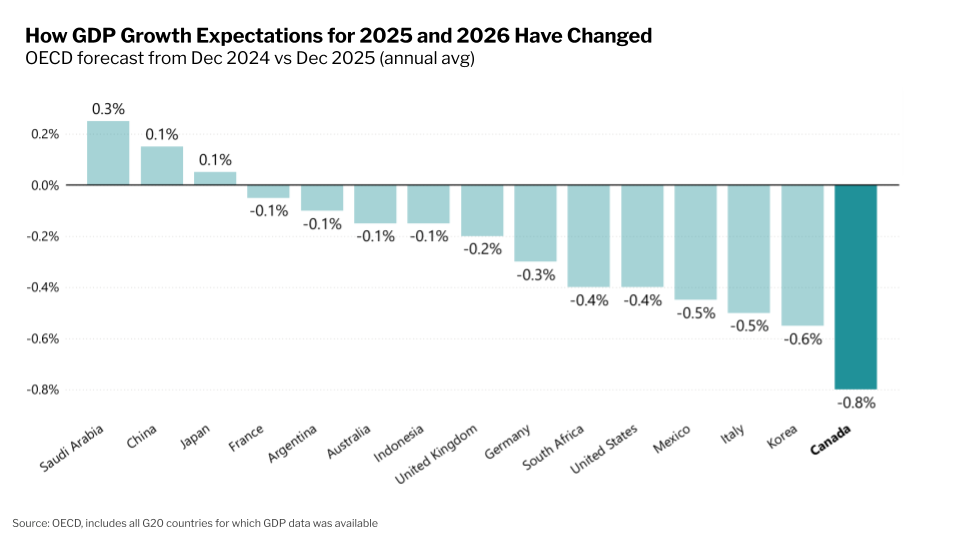
The recent OECD outlook answers that question. Compared to last year, Canada’s economic forecast has worsened more than any of its peers. Last December, the OECD expected Canada’s economy to grow 2% this year and next. Now, the numbers are just 1.1% and 1.3%, respectively.
That revision—down roughly 0.8% per year—might not sound like much but adds up to $50 billion in lost national income. That’s the difference between moderate growth and stagnation: whether families are getting ahead or just treading water. By comparison, the economic hit to the ringleader of the year’s drama, the United States, is expected to be just half that.
That said, and shocking though it might be, economic forecasts (and economists in general) are not always 100% accurate. Canada’s economy could beat expectations. In fact, by most accounts, it’s holding up better than expected. Recently-released Q3 growth numbers were surprisingly strong; and the recent upward revision to historical GDP figures suggest things weren’t quite as bad as we thought over the past three years. Besides, limping along isn’t so bad when your biggest trading partner and closest neighbour is throwing tariff tantrums.
But the downgraded outlook can’t be ignored, either. It’s a reality check that all those shake-ups are, indeed, taking a toll on the economy and Canadians aren’t wrong to be worried about job security.
It’s also a reminder that recent policy changes may be encouraging, but they’ll take time and, in some cases, more ambition to have any impact. Even with faster approvals, getting shovels in the ground on new major projects is still years away. And tax incentives and red tape reduction efforts are not yet proven; they may require more teeth to be effective.
All that to say, as we look ahead to 2026, it appears that Canada is set to keep limping along.
Have an idea for our next EconMinute? Email us at media@businesscouncilab.com.