




Canada is struggling to turn innovation into growth. Each year, the World Intellectual Property Organization (WIPO) ranks around 140 countries on their performance through its Global Innovation Index (GII). Not only does Canada underperform relative to its peers based on the latest report, but its ranking has also slid since 2011, falling from eighth place globally to 16th today.
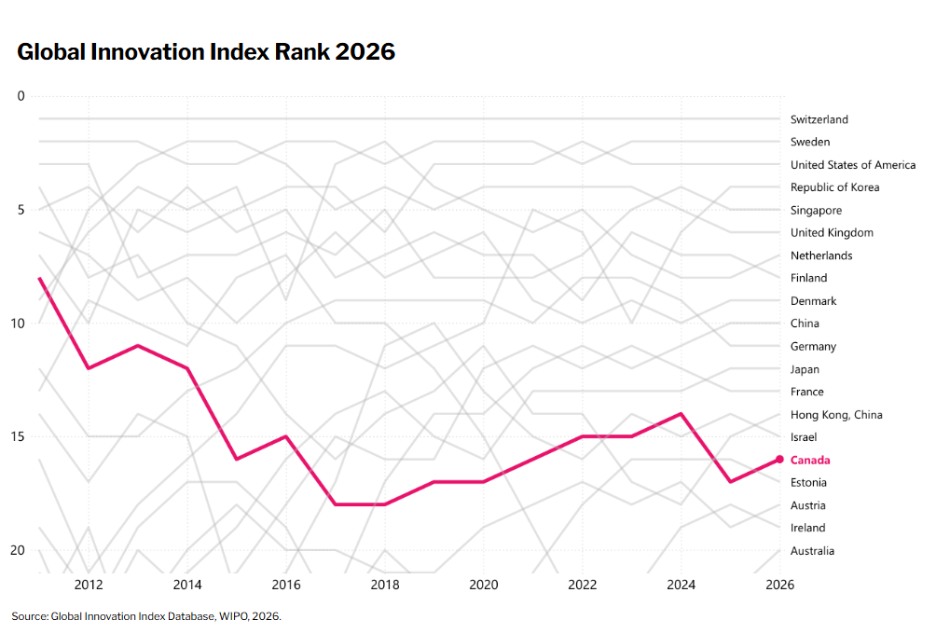
So what’s preventing Canada from generating the kind of innovation that drives growth?
In addition to reporting how well countries do overall, WIPO also breaks down the underlying components that feed into a country’s overall rank. The GII measures innovation across a range of categories covering both the inputs of innovation, such as institutions, human capital and infrastructure, as well as the outputs — the new ideas, inventions, brands and product designs — those inputs produce.
Based on the results, Canada’s innovation problem doesn’t stem from a lack of talent or knowledge. We rank 11th globally in human capital and research, thanks in part to world-class universities that collaborate with industry on research and development (R&D).
Nor is it a lack of strong capital markets. Canada ranks reasonably well in this area, including eighth on late-stage venture capital deals.
Instead, the biggest issue appears to be the broader business environment. Canada isn’t particularly good at creating the conditions for businesses and entrepreneurs to succeed. In this area, Canada ranks 32nd globally, down from 11th place in 2011.
Put simply, Canada doesn’t encourage entrepreneurship and risk-taking. The country ranks 33rd in the GII subcategory which looks at how supportive government policies, taxes and regulations are of entrepreneurship and whether innovation and risk-taking are rewarded. And even if they were better, businesses can’t count on those policies staying in place, because Canada also ranks poorly (25th) on policy stability.
In other words, smart people, good research and strong capital markets aren’t enough to overcome a poor environment for innovation and entrepreneurship.
As a result, businesses in Canada don’t innovate as much as those in other rich countries. They fund less than half of Canada’s R&D and that leads to poor results on the kind of economic outputs we expect innovation to generate. Compared to the size of its economy, Canada ranks 30th on patents and 91st on trademarks and a miserable 114th on labour productivity growth.
To its credit, the government has acknowledged the problem. Yet the instinct to fix it has generally been to respond with yet another niche support program. As Charles Lammam, principal of Policy Economics and contributor at The Hub, argued, Ottawa runs 166 programs across departments meant to increase innovation without evidence that they work and with feedback from businesses that they’re hard to navigate.
Folks who know that system best aren’t exactly impressed. In the Global Entrepreneurship Monitor’s expert survey, which feeds into the GII’s entrepreneurship indicator, Canada’s suite of government programs to support new and growing businesses score just 5.1 out of 10, barely above what the survey considers sufficient.
Have an idea for our next EconMinute? Email us at media@businesscouncilab.com.