




Budget week means Ottawa’s least favourite D-words are back: deficits and debt. Even with the revenue boost from high energy prices and corporate profits, Ottawa’s still set to pile on more debt in the coming budget, and borrowing isn’t getting any cheaper. Interest payments on existing debt is now the fastest-growing line item in the federal budget.
A big part of Ottawa’s plan to rein in operating spending (the day-to-day cost of running the federal government) is to trim the number of people it employs. After all, pay and benefits for public servants is the most expensive part of its operating budget.
As Prime Minister Mark Carney noted on the campaign trail last year, the federal workforce grew dramatically over the past decade, adding significant new costs for Canadian taxpayers without any noticeable improvement in results.
Last year’s budget set a specific target: shrink the public service to 330,000 employees by March 2029. That’s a cut of about 40,000 positions — and 10% below the 2024 peak.
How’s that going? The latest numbers suggest Ottawa is actually ahead of schedule.
Since the 2024 peak, the federal public service has shrunk by over 6%, representing almost 24,000 jobs. Much of that progress has come from some of the government’s largest departments. Employment at the Canada Revenue Agency (CRA) and Immigration, Refugees and Citizenship Canada (IRCC) has fallen by almost one-fifth, while Employment and Social Development Canada (ESDC) has reduced staffing by about 9%. Together, these departments account for over one-quarter of all federal public service jobs and nearly three-quarters of the overall reduction since 2024.
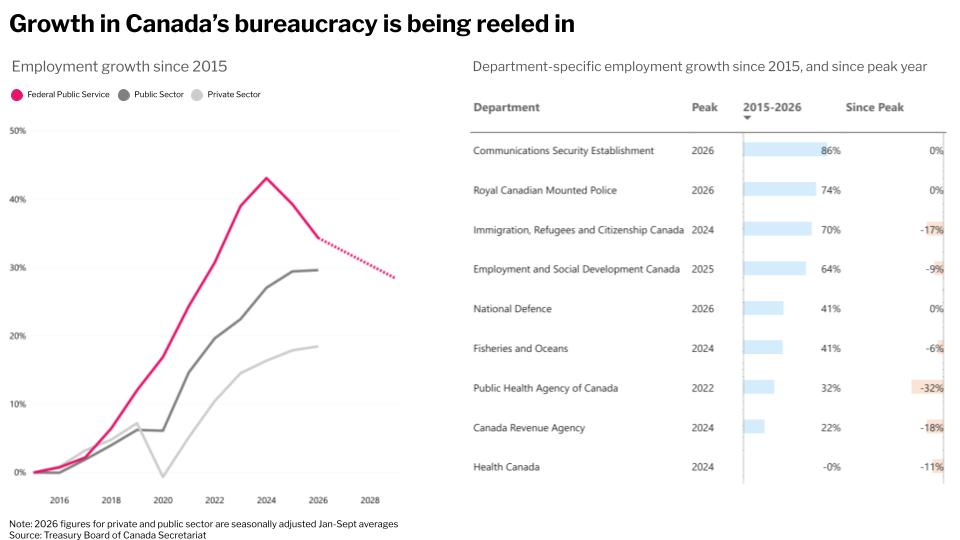
Other large departments have also seen staffing cuts since the 2024 peak. These include the Public Health Agency of Canada (-32%), Health Canada (-11%), Indigenous Services Canada (-7%), and the Department of Fisheries and Oceans (-6%).
The federal government isn’t just cutting, though; it’s also shifting priorities toward defence and security. Even as overall federal government employment is falling, the Communications Security Establishment has grown by 15% since 2024, National Defence by 11%, and the RCMP by 9%.
While Ottawa may be ahead of schedule in meeting its 10% reduction target, the federal bureaucracy remains much larger than it was a decade ago. Even after recent cuts, employment in the federal public service is still 34% larger than it was in 2015. That’s almost twice as fast as total private sector growth over that period, and well above the 29% growth in broader public sector jobs — including teachers, nurses, police officers, and other public sector workers.
Even those federal departments hardest hit by recent cuts are still far bigger than they were 10 years ago. ESDC employment remains 64% higher than 2015 levels, IRCC is 70% higher, and even the CRA still has 22% more staff than it did before the run-up began.
In fact, if and when the government achieves its target, it would simply return the federal public service to approximately the same size it was in 2022 — 28% higher than it was in 2015.
There’s also another challenge. Reducing the overall public service headcount doesn’t necessarily mean the federal government saves money. Automatic pay increases and promotions can mean payroll costs rise even as the total number of workers falls. For instance, nominal spending on personnel in the first five months of 2025-26 was 8% higher than in the same period last year. To be sure, that increase is lower than it otherwise might have been, but it also illustrates how difficult it can be to make cuts that are deep enough to meaningfully impact the underlying fiscal challenge.
Ottawa deserves some credit for its early progress. But a modest cut to the number of bureaucrats won’t, by itself, make running the federal government more fiscally sustainable. Government departments need to deliver value and results for Canadians in proportion to their operating costs. At the end of the day, a sustainable public sector depends on a strong private sector to pay for it. Ensuring the latter will go a long way toward creating the former.
Have an idea for our next EconMinute? Email us at media@businesscouncilab.com.