




From the Canada-Alberta MOU implementation agreement to last week’s announcement of an October referendum on independence, Alberta has dominated recent headlines. But what’s actually happening on the ground has gotten less attention. Alberta’s economic outlook for the year is much brighter today than it was just a few months ago, but it’s not all sunshine and rainbows. Here’s what you need to know.
Alberta is set to pull even further ahead of other provinces in 2026
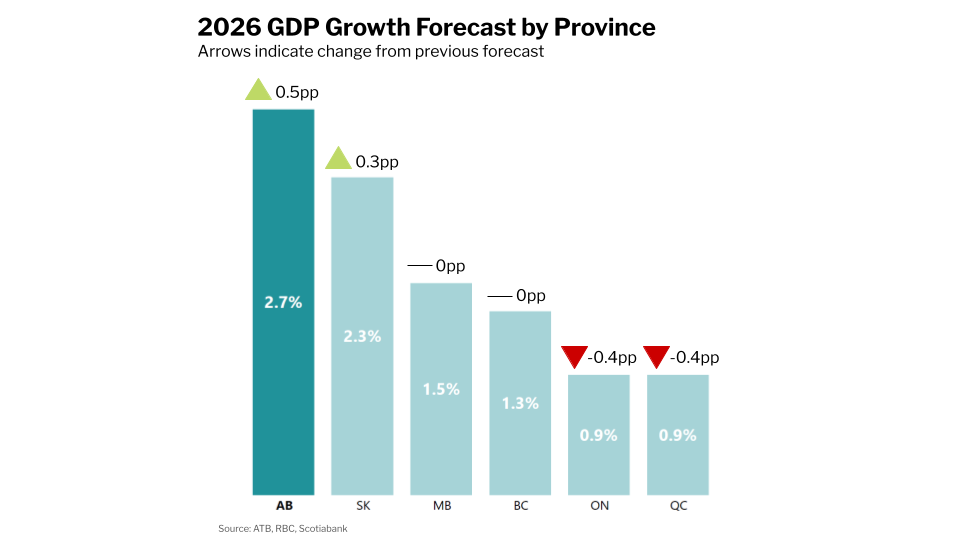
Growth is set to slow amid conflict in the Middle East for virtually every major economy. Canada is one of the exceptions, and the reason is Alberta. The province’s economy is expected to grow by 2.7% in 2026, up from the roughly 2% forecast before the conflict, widening the gap with every other province.
Importantly, population growth is also slowing. That means these gains will translate into real, if moderate, wealth gains for Albertans, not just a bigger pie shared among even more people.
Global demand gives Alberta’s energy sector a boost, if not a boom
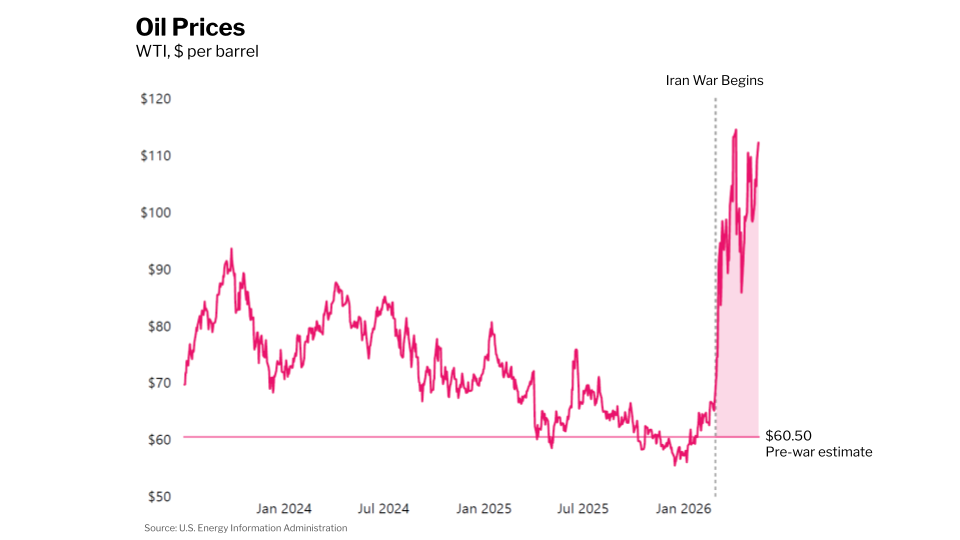
Behind Alberta’s improved outlook is the province’s large energy sector. With the Strait of Hormuz disrupted, the world is scrambling for more oil, and Alberta is set to do its part. The sector’s outlook has improved dramatically, and nearly all exploration and production companies plan to increase output and capital investment this year. Pipeline capacity won’t be an immediate constraint, either. Over the next few years, planned expansions of existing pipelines will make room for another 600,000 barrels a day on top of the roughly four million per day currently leaving the province.
Consider it a boost, not a boom, though. Producers don’t know how long high prices will last, and, over the last decade, have grown more cautious with capital investment, with government policy seen as a major risk. The MOU could change that, but it will take time.
High oil prices flip Alberta’s fiscal picture from a deficit to a likely surplus
A boost for energy investment is a boon for the province’s bottom line. As of the time of writing, oil prices are about $100 US per barrel. If they average out to about $83 per barrel for the entire year (instead of the $60.50 assumed in the budget), Alberta’s books will swing from $9.4 billion in the red to $6 billion in the black — a turnaround of more than $15 billion. That would be among the largest fiscal swings in the province’s history and a stark contrast to other large provinces, which won’t see a reprieve from their own fiscal deterioration. If prices average out closer to $90 for the year, that will generate another $5 billion.
What this means for the province depends on how the unexpected surplus is used. Fiscal rules require half of any surplus to go toward paying down Alberta’s more than $90 billion in debt while the other half is more flexible. It could go toward the Heritage Fund, which wasn’t expected to get any love for a few years, or toward a one-time expense. The fiscal rules themselves were set to be reviewed but that was before the turnaround.

Residential construction is cooling. Major projects are picking up the slack, mostly
Alberta’s population growth has cooled and, with it, a major driver of the province’s economy: residential construction. The good news, however, is that industrial and commercial construction are increasingly filling the gap. Investment in residential construction is down 10% over the last year while non-residential is up 22%. The shift is evident in the province’s major projects list, too: 68% of large projects currently underway are non-residential, rising to 93% among those in the hopper.
That said, because of the sheer size of residential versus non-residential construction, the latter isn’t quite enough to offset weakness in new housing. But that could change. Several big projects are on the horizon: three dozen data centre projects currently applying to connect to Alberta’s electricity grid; E3 Lithium advancing Phase 2 of its Clearwater Project; and a major infrastructure buildout at 4 Wing Cold Lake, one of Canada’s largest air bases. And recent reforms to Canada’s system of major project reviews, focused on reducing duplication and ensuring speedy approvals, could help get shovels in the ground sooner.

Alberta’s labour market has finally found its footing, but not for everyone
After a period of strong private sector job growth and even stronger population growth in recent years, the labour market has come back into balance. Jobs have found people and people have found jobs. Unemployment is now in line with the national average at just under 7%.
But that doesn’t mean everyone is alright. Young adults in Alberta are struggling to find work. Unemployment among those aged 15 – 24 is roughly double the provincial average — a national concern as much as a provincial one. Recent immigrants aren’t far behind. With overall business sentiment in the province still tepid, the labour market may remain challenging for these groups.

Looking ahead
Improved outlook aside, Albertans remain uneasy. Though household finances are in reasonable shape, most (56%) believe the provincial economy is worsening. Many recognize Alberta will fare better than most provinces but are nonetheless worried about what the Iran conflict means for prices and prosperity. That unease is understandable. Like everywhere else, Albertans are facing higher prices. Meanwhile, much of what’s driving Alberta’s boost is outside the province’s control and could turn on a dime if oil prices drop.
Have an idea for our next EconMinute? Email us at media@businesscouncilab.com.