




Last week, the Government of Alberta released its first look at how the province’s finances are tracking against initial expectations when the budget was tabled back in February. A lot has changed since then, and the fiscal update bears this out. Here are five things to know.
1. High oil prices are set to swing the province into a surplus
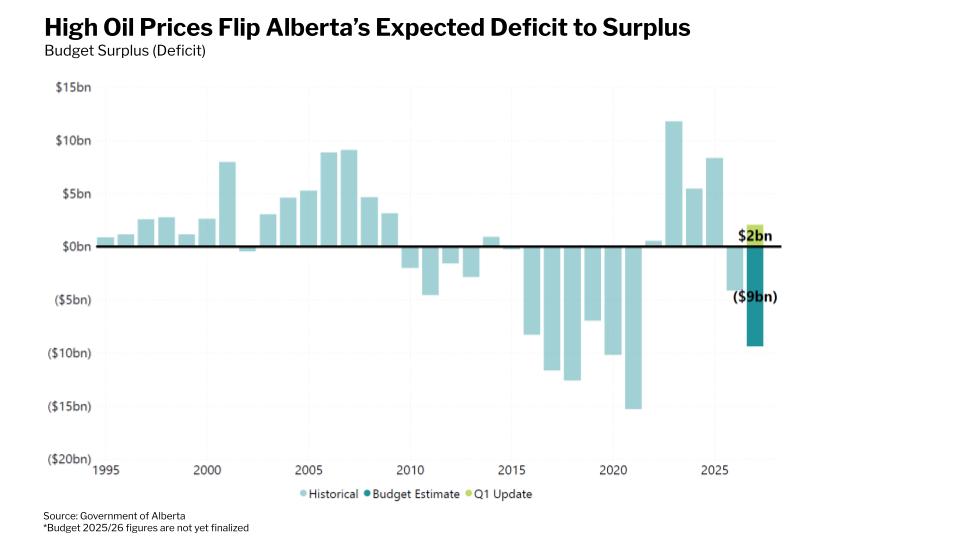
Nothing makes or breaks the Alberta budget quite like oil prices. When the budget was tabled, prices were expected to average just $60.5 per barrel, based on the WTI benchmark price, due to a global supply glut. OPEC was ramping up production and there were concerns Venezuelan barrels would increasingly make their way to the Gulf Coast, displacing Canadian supply. As a result, the province expected to be $9.4 billion in the red — a sizeable deficit for a budget of $84 billion.
Instead, prices soared. Just two days after budget day, the U.S. and Israel launched a surprise attack on Iran, and the closure of the Strait of Hormuz shortly thereafter sent global prices flying. The fiscal update shows prices averaged $93 per barrel in the first quarter, $33 above forecast.
On an annual basis, every dollar that oil prices exceed budget expectations adds about $680 million to provincial coffers. So, that $33 gap adds up fast and total revenue is now set to be $11.7 billion higher than Budget 2026 expected. Of that, $9.7 billion of that will come from higher oil prices, with the rest coming from stronger corporate and personal income taxes. That flips the $9.4 billion expected deficit into a $2 billion surplus.
2. The actual surplus may be much higher
That $2 billion figure assumes oil prices average $73.5 through the fiscal year, or around $67 for the remaining three quarters. That estimate is fairly conservative compared with forecasts from the EIA and Goldman Sachs. July and August have already come in hotter, in the low $80s, and prices sit even higher today. To meet that assumption of $73.5, oil prices for the rest of the fiscal year would need to average just $63 per barrel from September onward. In other words, oil prices could drop by $20 tomorrow and remain there until March, and the provincial surplus would still be about $2 billion.
Under a less conservative scenario, where prices average around $70 for the rest of the year, the surplus could grow by another $4 billion. If that were to occur, the province would have surplus cash to either pay down debt or make an additional contribution to the Heritage Fund to support the province’s future revenue stability.
At the same time, uncertainty works both ways. It may seem unlikely now, but oil prices could just as easily fall later in the year. The Strait could open more fully and quickly than anticipated, pulling prices back down. Likewise, the escalating trade war with the U.S. could squash American demand for Canadian products, including crude. Longer-term, the U.S. could increasingly tap into Venezuelan supply, as threatened in President Trump’s announcement of the “biggest oil deal in world history.”
3. The budget remains as reliant on oil as ever
Case in point: a single quarter of high oil prices was enough to flip a $9.4 billion deficit into a surplus — a good reminder that Alberta’s economy may have diversified in terms of jobs, but not in terms of public finances.
In recent years, royalties have generated roughly $20 billion of annual government income, and this year is likely to come in even higher, at around $23 billion, or about a quarter of the province’s revenues. While that share sits well below historical peaks as royalties topped 50 per cent of revenue in the early 1980s, it’s also well above the 5-to-10 per cent range of the late 2010s.
Somewhat ironically, higher resource revenues haven’t necessarily eased Alberta’s fiscal challenges in the past. Revenue windfalls have tended to increase the pressure to spend. And since the windfall is temporary but the resulting spending increases were more permanent, the province has often found itself in a new fiscal challenge when royalties inevitably return to more normal levels.
This time, though, appears to be different. So far, the oil windfall is not set to translate into a permanent increase in spending. As Minister Nixon put it, Alberta will not “commit temporary revenues to permanent expenses.”
4. The province’s economic performance is stronger than expected
Alberta’s economy is now expected to grow faster than forecast at budget time thanks to high oil prices and a growing population. Real GDP is set to expand 2.3 per cent this year and 2.5 per cent next, up from assumptions of 1.8 per cent and 2.3 per cent growth in the 2026 budget. The province is attracting people, creating jobs and building homes faster than anticipated, and Albertans’ total income — which captures income across the province — is set to grow more quickly as well. This improving outlook aligns with the Business Council of Alberta’s CEO Pulse Survey which finds that, headwinds aside, business leaders are optimistic about the year ahead with 65% expecting economic conditions to improve.
That said, individual Albertans still face real pressures. High oil prices are hitting consumers at the pump while wage growth is tracking roughly in line with earlier estimates. Overall, the province expects prices to rise 2.6 per cent this year, based on the Consumer Price Index, while weekly earnings will just keep pace, at 2.6 per cent.
5. There was a modest increase in spending due to the one-time Alberta Energy Rebate
Generally speaking, the province held the line on spending with one exception. To support Albertans facing high gas prices, the Government of Alberta introduced a one-time $100 rebate for adults in households with incomes below $225,000. The fiscal update pegs the cost of this program at roughly $357 million.
The rebate was offered in place of an automatically-triggered suspension of the provincial fuel tax from July through September under the Fuel Tax Relief Program. The suspension typically kicks in when oil prices exceed a certain threshold for long enough. But rather than let it take effect, the province instead put in place the $100 rebate, arguing it would increase savings for the average Albertan by about 50 per cent.
The true cost of the program, however, may prove to be less than budgeted. Unlike the automatic fuel-tax suspension, most Albertans have to apply for the rebate and uptake has lagged. Because that $357-million figure is roughly what the program would cost with full uptake, the rebate’s actual cost may come in lower and more in line with the cost of the Fuel Tax Relief Program. That said, government has suggested that more support may be provided, and the $2 billion contingency fund set aside for emergencies could help to pay for it.
Overall, the fiscal update shows that Alberta’s finances are in much better shape than expected. While Albertans may not see an immediate impact, it’s nonetheless good news: higher royalty revenues mean fewer tax dollars will go to interest on debt and more to the things that matter. In addition, it reduces the risk of future tax increases or spending cuts to important services like health and education. However, for the provincial government, it’s also a good reminder of just how many eggs are in the resources basket and the value of securing new sources of revenue, such as the Heritage Fund, to support greater stability longer-term.
Have an idea for our next EconMinute? Email us at media@businesscouncilab.com.