




Affordable travel is essential in a country as large as Canada. But right now, it’s too expensive for many Canadians to fly within their own borders. That’s an issue year-round, but it especially stings during this summer vacation season as more Canadians are avoiding U.S. travel.
The good news is that flying has actually become much more affordable in recent decades. Canadians pay about half the price they did back in 1995 for a domestic base fare, inflation-adjusted. That means far more Canadians can travel, and more often.
But while base fares charged by airlines have been cut in half, additional fees charged by the federal government have increased by 65%. These fees used to be a tenth of the total ticket price; now they’re a quarter of what you pay. Because of this increase, Canadians now pay around $25 more for each one-way flight than they would have if fees stayed the same. For a family of four on a round-trip Canadian vacation, that’s almost a $200 cost increase.
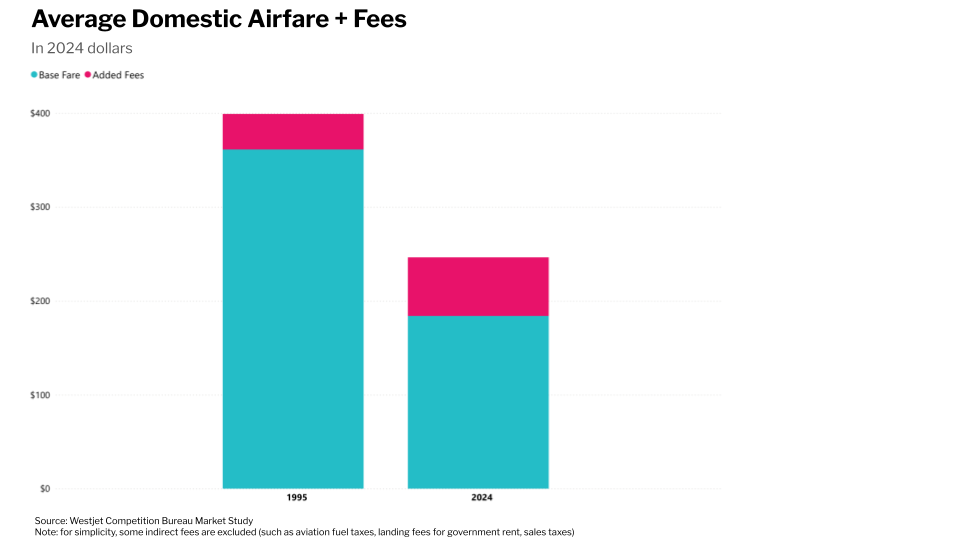
Most of the added cost comes from direct fees—like the Airport Improvement Fee ($34) and the Air Travellers Security Charge ($13)—which are listed on your bill at checkout. Other fees are paid by the airlines but passed onto passengers in their base ticket price, like Air Traffic Control ($16), Aviation Fuel Taxes ($3), and Airport Rent ($7).
All told, direct and indirect fees add up to about $75 per one-way ticket, on average.
Because the added fees are fixed, you can end up paying more in fees than on the flight itself. At the time of writing this, a basic one-way Calgary-Vancouver flight can cost as little as $28, but adding on just the directly-charged fees brings the total cost to $76.
Canada has higher fees than other countries because it has a “user-pay” model. This means that air travel is supported by those who use it most, which is a reasonable system. And the fees aren’t for nothing—they support vital parts of flying like security, air traffic control, and airport infrastructure.
But it’s worth putting them into perspective: a study found that if Canada halved just the cost of added fees there’d be 12 million more one-way domestic flight boardings each year. And that added demand would be enough to sustain another airline the size of WestJet, boosting competition in the domestic market.
By rethinking the fees that drive up domestic air travel costs, the federal government can make flying more accessible, boost competition, and connect Canadians across the country. It’s a simple yet high-impact solution to deliver real benefits for Canadians—quickly.
To learn more, read our commentary here.
Have an indicator you want us to look into? Email us at media@businesscouncilab.com.