




While energy and pipelines have understandably drawn much of the attention in recent weeks, the Calgary Stampede, which just wrapped up, is a reminder of the province’s deep roots in farming and ranching.
Agriculture isn’t just an important part of Alberta’s heritage. It’s also a major economic advantage for Canada.
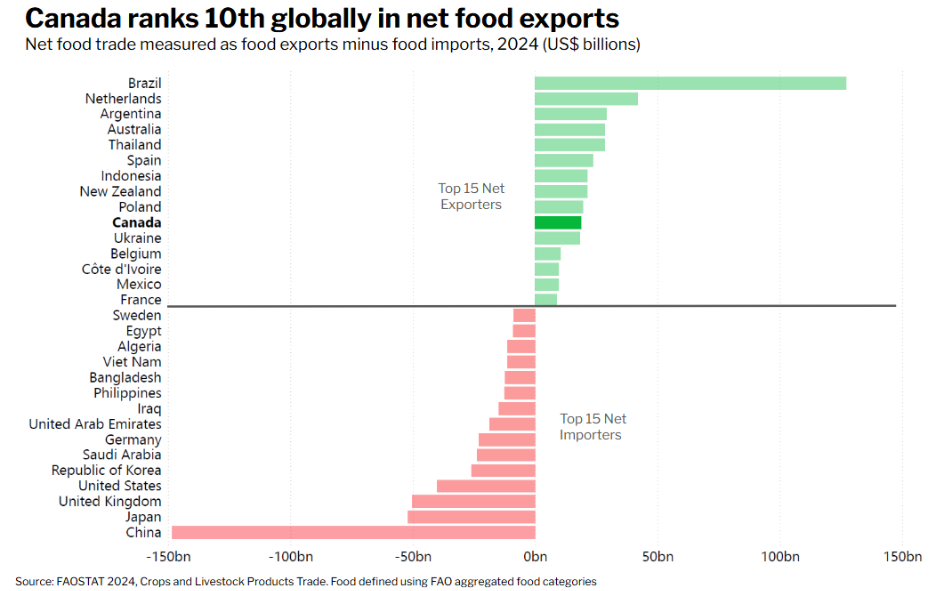
Canada is an agricultural powerhouse. Despite being home to less than 0.5% of the world’s population, it ranked as the 10th largest net food exporter in 2024, exporting far more food than it imports and helping feed markets well beyond its borders.
That is according to the Food and Agriculture Organization of the United Nations (FAOSTAT) database which reports the total value of food — defined as crops and livestock products — imported and exported by roughly 200 countries. There’s no single right way to measure who feeds the world, but this database allows consistent comparisons across countries with different currencies, food needs, and agricultural sectors. And by that measure, Canada is a leader.
Behind Canada’s agricultural prowess are large exports of wheat, canola, pulses, pork, and beef. Much of that comes from the Prairies, which account for 40% of the country’s food exports, based on food-related categories in Canadian trade data.
Leadership in agriculture provides Canada with an important advantage: not only is food an essential need, but global demand is also expected to grow with population and incomes. Countries that consistently produce more food than they consume are likely to benefit.
Climate change may even further strengthen Canada’s edge. It’s expected to reshape where food is produced, straining many agricultural regions through heat, drought, and water shortages. Though Canada isn’t immune to these challenges, it does have some things going for it, including a cooler climate than many other major agricultural producers, a large land base, and abundant freshwater. Agriculture and Agri-Food Canada projects longer growing seasons in some regions and, over time, more land becoming suitable for agriculture.
But natural advantages alone won’t be enough to capitalize on the opportunity that increased agriculture production represents.
Although Canada’s agriculture and agri-food exports have continued to grow, competing countries such as Brazil have grown even faster. On a different measure of total exports, Canada has fallen from the world’s 5th largest agricultural exporter in 2000 to 7th today and could slip further over the next decade.
One reason for this relative decline is that Canada’s agricultural productivity growth has lagged many of its competitors. The country has fallen behind many international peers in developing and investing in technologies that help farmers produce more food, use resources more efficiently, and adapt to changing conditions. Canada was once a global leader in agricultural research and development, outperforming the United States, Japan, and the OECD average. That is no longer the case.
The federal government’s new National Food Security Strategy recognizes the importance of Canada’s food sector. But its primary focus is improving food affordability for Canadians. And its scale is fairly limited, amounting to roughly $3 billion over ten years, with most new funding aimed at increasing competition in the grocery sector or boosting domestic production. Little of it is focused on strengthening the industry’s global competitiveness through research and development, investment attraction, or export capacity.
Canada already has many of the ingredients needed to build on its position as a top global exporter in agriculture. The bigger question is whether we will invest enough to do so. Feeding a growing world will increasingly depend not just on Canada’s natural advantages, but on its ability to innovate, compete, and reach global markets.
Have an idea for our next EconMinute? Email us at media@businesscouncilab.com.