




In its first week back in Ottawa, the federal government introduced a 243-page whopper of a bill to help Canada build major projects faster: the Building Canada Strong Act (Bill C-39).
The new Act sounds awfully similar, in name and intent, to last year’s Building Canada Act (Bill C-5). But whereas the original Act granted certain projects a fast track to approval, the new Act aims to fix the whole of the system itself, to get all projects approved more quickly without compromising on regulatory rigour. As Minister of Transport Steven MacKinnon put it, “This legislation will give our country the tools we need to build more, better and more efficiently.”
Business groups across Canada have rightfully welcomed it as a potential cure to Canada’s regulatory malaise.
And yet this week, the West Coast Pipeline is expected to be designated as a project in the national interest in order to be fast tracked under the original Bill C-5 (Building Canada Act).
Some may be questioning why Canada is still relying on the short-term solution created by Bill C-5 when C-39 represents a fix to the overall system. And, in a perfect world, all projects would move forward quickly enough that no fast lane is needed, and government wouldn’t need to intervene to determine which projects matter most to the country.
Part of the reason that this pipeline will be designated through Bill C-5, is that not only is C-39 not yet in force, but there’s also no guarantee the new bill will pass or how long it will take to do so. A lot depends on how much opposition there will be to the proposed changes. And even if/when the bill does pass, the mechanisms to speed up project approvals in C-39 are ultimately untested. While there’s a lot to like in the new bill, there are question marks as well. One of the biggest is that the government commits to conducting project reviews within a year, but the new legislation still gives it several opportunities to stop the clock on that process. It will take time to determine how solid that one-year commitment is in practice.
As well, C-39 doesn’t override the other Act. In fact, it expands on parts of it. If passed, the new bill will extend fast-tracked treatment, and in some cases full on pre-approval, to entire regions — be it a trade corridor or a zone of industrial production — designated as being in the national interest.
A good way to think about the distinction between the two is that the original Act creates a fast lane through concierge service and regulatory flexibility, via the Major Projects Office, whereas the new bill aims to fix the entire highway system, including the fast lane.
Most importantly though, there’s something fundamentally different about designation under the original Act. The role of government shifts from deciding whether a project should be approved to deciding how — what conditions it must meet to move forward. In other words, the designation of the project itself has already answered the first question. What’s left is simply making sure government uses every resource at its disposal to address the second part quickly, lessons from which are intended to support further reform to legislation governing all projects.
All this to say, if Canada wants to see a pipeline built, and built quickly, the national designation under the original Act is still likely to be the surest bet to get it done. And if there was ever a project that fits that bill, it’s the West Coast Pipeline.
This pipeline would cut Canada’s reliance on the U.S. market, deliver meaningful economic benefits to Canadians, and, as the recent Trans Mountain expansion (TMX) has shown, offer an opportunity to advance economic participation of Indigenous people — three of the key factors the federal government has identified as important in determining a project’s significance to the nation.
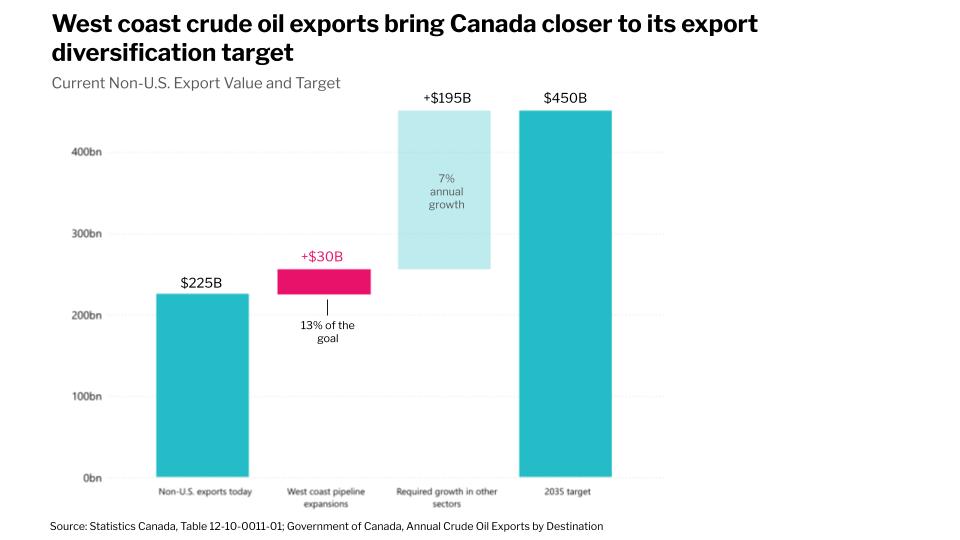
In fact, it’s hard to find a single project with greater impact in diversifying trade: our estimates suggest the additional pipeline capacity would push the share of Canadian crude headed to non-U.S. markets from roughly 15 per cent to 23 per cent, putting a real dent in our reliance on the U.S. That’s one project alone delivering about 13 per cent of the Prime Minister’s goal of doubling non-U.S. exports within a decade.
While the new Act arguably deserves a lot of credit, for now, a national designation still matters.
Have an idea for our next EconMinute? Email us at media@businesscouncilab.com.