




Why is it so hard to get things built in Canada? New international data helps explain why.
In a recent EconMinute, we highlighted new findings from the World Bank’s recently launched Business Ready (B-READY) initiative. B-READY compares business competitiveness across countries using ten categories of activity, from starting a business to paying taxes to international trade.
Each category is evaluated across three dimensions: the regulatory framework itself, government services that help businesses comply with regulations, and system efficiency or how smoothly the system actually works. Each of these categories is further broken down into more detailed categories and indicators to provide a clearer picture of where countries perform well and where they fall short.
Our previous EconMinute showed that, overall, Canada’s biggest weakness is the regulations themselves. Across categories of business activity, Canada earns a C grade for its regulatory framework, ranking 33rd out of roughly 100 economies — closer to China than to the United States.
However, these topline results mask important differences across categories. In some areas, the main challenge is the rules themselves. In others, it’s how the system operates in practice, including gaps in public services and inefficiencies in regulatory processes.
This EconMinute focuses on where Canada’s regulatory system falls short in how it works day to day, while the next examines where the rules themselves are a major barrier to Canadian competitiveness.
Slow and costly
A clear finding emerges from the data: many key business processes in Canada take longer and cost more than in other advanced countries.
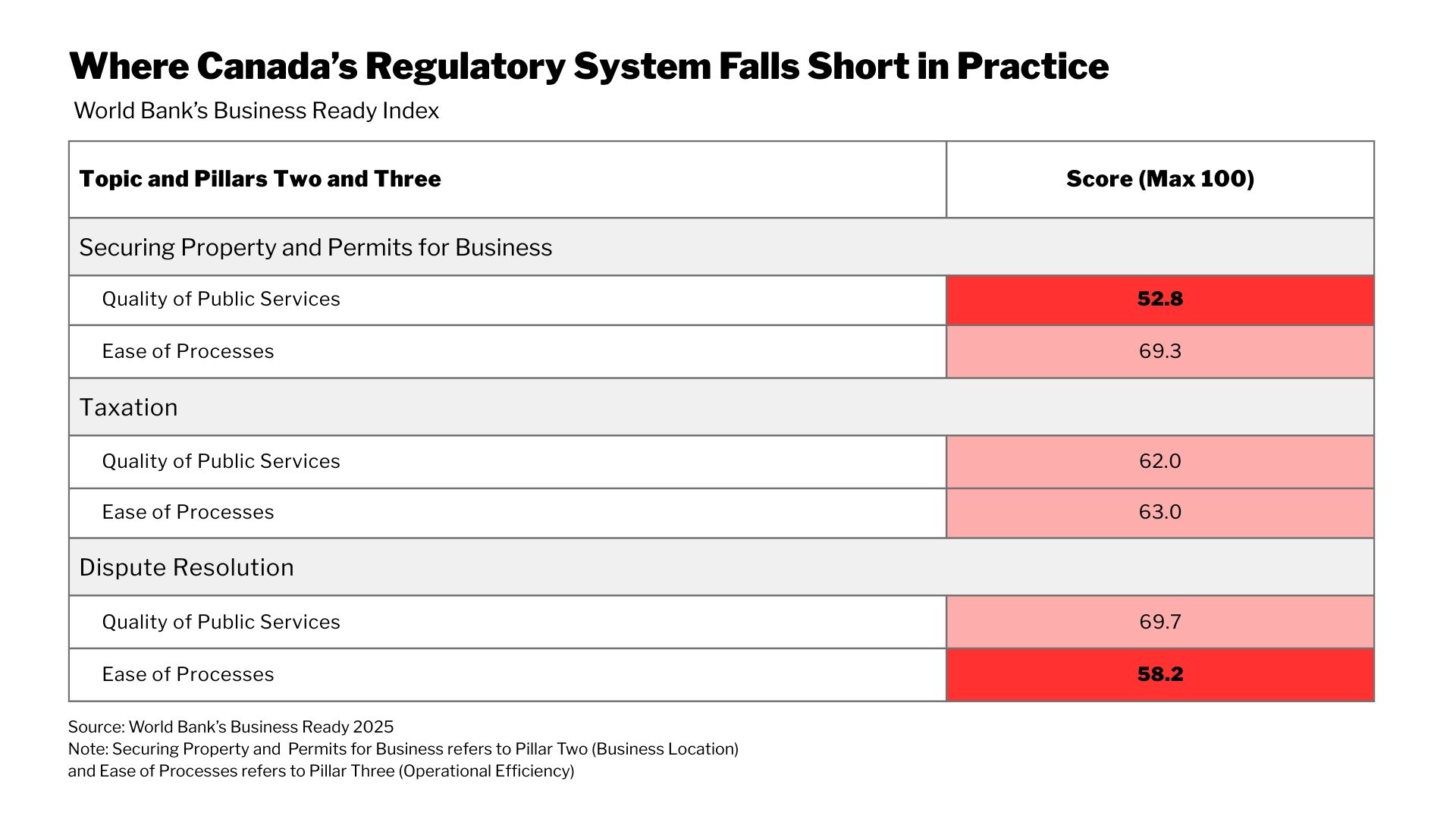
For instance, Canada earns just 69 out of 100 points for the efficiency of processes related to setting up and expanding operations. Within this general grouping, Canada scores poorly on the time required to obtain a construction permit, which typically takes around 30 days — more than twice as long as in the U.S. Canada also performs poorly on both the time and cost required to transfer property between businesses, a routine process that’s essential for investment and expansion. Delays like these don’t just affect businesses, they mean higher housing costs from slower construction and fewer investments that create good jobs and strong wages for Canadians.
Canada’s performance is even more concerning when it comes to environmental permits, where the typical approval takes nearly a year from application to final decision. Canada scores so poorly on this measure that it earns literally zero points. Many other advanced economies process permits far more quickly. For example, Ireland, which earns near full points on this measure, issues environmental permits in an average of just 28 days. And cost is another major barrier, as the total expense for obtaining an environmental permit in Canada is estimated to exceed $400,000. This is at least four times higher than in several comparable countries.
Resolving legal disputes is similarly challenging. Canada earns only 58 out of 100 points for the efficiency of processes related to resolving legal disputes. While the B-READY results show Canada’s courts are widely viewed as fair and reliable, litigation through the courts is both time-consuming and expensive. On this measure, Canada scores just 10 out of 33 points, ranking near the bottom among other advanced countries. The initial court process alone, from filing a complaint to receiving a judgment, is estimated to take close to two years, with significant legal costs along the way. When resolving disputes becomes this burdensome, it discourages businesses from taking risks, entering contracts, and pursuing new opportunities in the first place.
Hard to navigate
Likewise, the regulatory system can also be difficult to understand and navigate. As a result, firms in Canada often spend significant time and money simply figuring out what the rules mean and how to comply with them.
For example, while it’s relatively easy to start a business in Canada, actually setting up or expanding operations, including securing property and obtaining permits, is much more difficult. In this area, Canada scores just 53 out of 100 points on the quality of public services that support businesses, ranking near the bottom among assessed high-income OECD economies.
A key reason is that government systems are not fully integrated. This is especially evident in building permits and property transfers, where businesses often have to coordinate their applications across multiple departments, submit the same information repeatedly, and wait for each agency to conduct its review before proceeding. On these measures, Canada scores zero out of 10, and five out of 10, respectively.
That same lack of integration affects taxation as well. Canada scores just 62 out of 100 on the quality of public services supporting businesses in managing their taxes. Although online tools exist, they are not fully integrated, meaning businesses must use multiple platforms to file, pay, and register for different taxes, which adds time, complexity, and administrative burden.
Why this matters
Canada is effectively making it harder than it needs to for businesses to invest, build, and expand. When projects take longer and cost more to complete, fewer investments move forward. In turn this means fewer jobs, slower growth, and lower living standards. If Canada wants to compete globally, it needs a regulatory system that protects what matters while making it easier to get things done.
About this Series
Business investment is a key driver of economic growth and Canadian prosperity. As Budget 2025 notes, “Canada needs a sea change to reverse Canada’s history of weak private sector investment.”
This EconMinute is part of a multi-part series looking at the regulatory barriers underlying Canada’s investment challenge, and what’s needed to meet the federal government’s investment ambitions.
The series sets the stage for the release of From Barriers to Breakthroughs. This is a plan for system-wide regulatory reform, including where to start, what to fix, and how to make reform endure. Grounded in real-world business experience, its objective is to set out a practical path forward to build lasting, system-wide reform, unlock investment, and support long-term prosperity.
Have an idea for our next EconMinute? Email us at media@businesscouncilab.com.