




A few short weeks ago, Canada agreed to partially roll back the 100% tariff it imposed on Chinese electric vehicles (EVs) in 2024, allowing up to 49,000 to enter the Canadian market at the previous 6.1% tariff rate. In exchange, China removed its tariffs on canola meal, peas and certain seafood products, and lowered the tariff on canola seed to 15%.
This move was met with mixed reactions across Canada. While some were concerned about the implications for Canada’s auto industry, agriculture producers, especially those on the prairies, were pleased to see access to the Chinese market re-opened; canola products are one of Canada’s most economically significant exports.
While it is a return to the pre-2024 status quo, the deal was both economically and politically notable given the importance of diversifying Canada’s non-US exports. It also sparked speculation that the federal government may see the move to re-open the Canadian market to Chinese EVs as a way to help meet its zero-emissions vehicle (ZEV) mandate.
The mandate, which is currently paused and under review, requires that all new passenger vehicles sold in Canada be zero-emission by 2035, with interim targets along the way. The first milestone, initially set for this year but now pushed to 2027, requires that 20% of new vehicles be ZEVs. Current sales are far off that mark at just 9% and it is highly unlikely that Canada will meet that 2027 target.
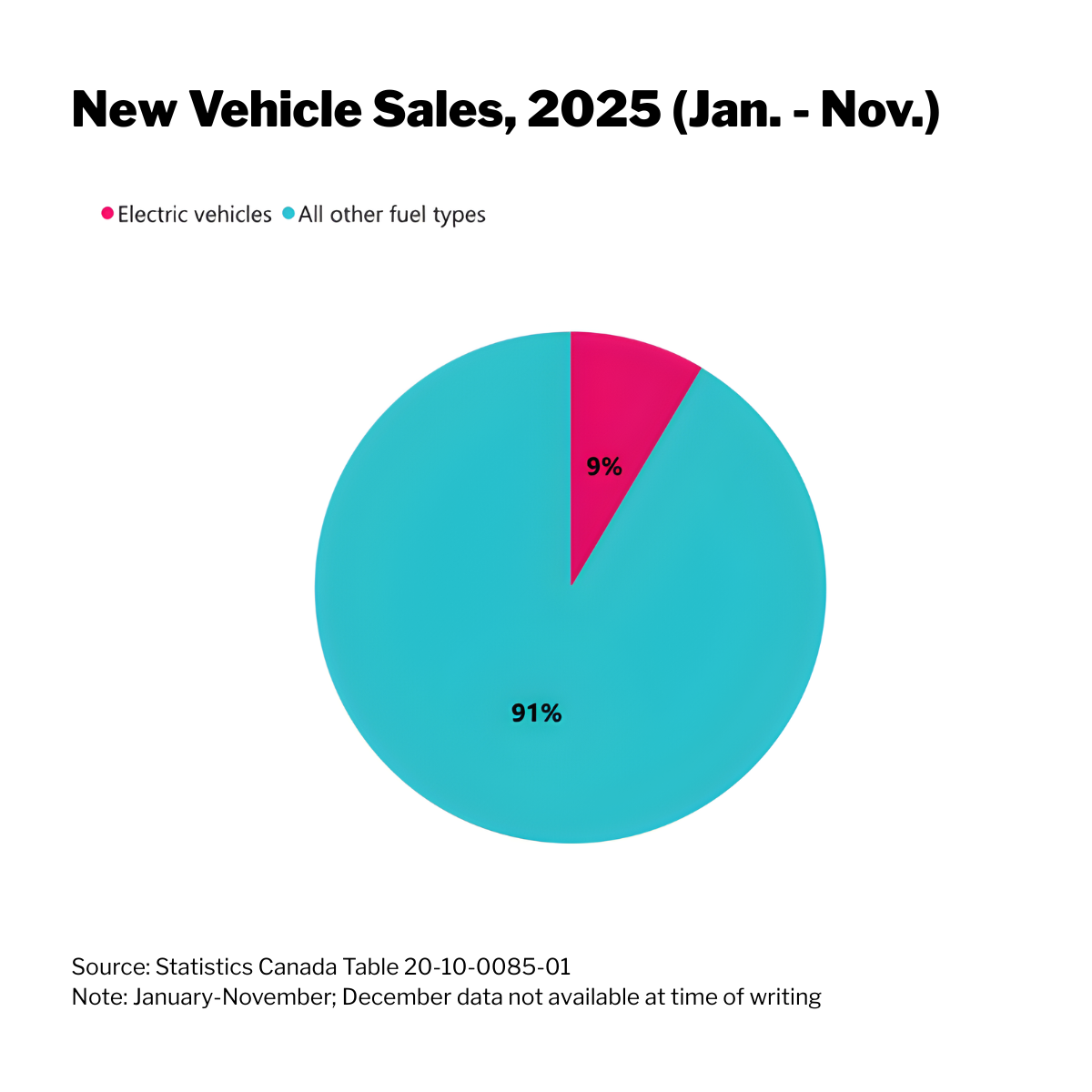
Will lower tariffs on Chinese EVs at least move Canada closer to that goal? Based on the numbers, the impact will likely be minimal.
Yes, lowering the tariff will mean lower prices for some EVs, probably leading to more purchases. That is the law of demand, after all. The structure of the import quota could also contribute, especially in the long-term: by 2030, 50% of the quota will be reserved for lower-cost EVs priced at or under $35,000.
Even so, the overall impact on EV adoption is likely to be modest. The number of Chinese EVs driving from coast to coast will ultimately be constrained by either the quota itself or by consumer demand. Before the 100% tariffs were put in place, Canada was already importing about 49,000 EVs from China—which is why the number was chosen. The new quota doesn’t represent an increase in supply compared to recent years.
While the quota is expected to rise over time, reaching 70,000 vehicles within five years, higher limits do not guarantee more purchases. Recent trends suggest weaker, not stronger, demand for EVs. Over the last year, for instance, EV sales collapsed by 40%, driven by the pause or cancellation of federal and provincial incentive programs, economic uncertainty, range anxiety, and consumer backlash against Tesla. More broadly, constraints beyond price limit adoption, including electricity generating capacity and the availability of charging infrastructure.
Even under generous assumptions—where the full quota is used in 2030 and represents net new purchases, not just folks switching from competitor EVs to Chinese ones—it’s still 20 percentage points below the target for that year. Achieving it would require a 48% compound annual growth rate year-over-year, from 2020-2024, it was 2.5%.
One thing is clear: Canada wasn’t on track to meet its ZEV target, and the recent tariff lowering doesn’t meaningfully change that trajectory. The deal amounts to a return to the status quo which may slightly increase purchasing but doesn’t resolve the constraints holding back adoption.
Have an idea for our next EconMinute? Email us at media@businesscouncilab.com.