




What you need to know:
The Alberta economy continues to move forward but more cracks are appearing in its armour. Albertans report their personal finances are faring reasonably well, and businesses are more optimistic than the Canadian average. However, Canada’s economy has been slowing significantly, particularly compared to the United States, and while Alberta continues to fare better than average, we are no longer immune to these national headwinds, and this quarter’s snapshot bears that out.
It has become clear that the labour market has meaningfully changed—with unemployment currently at 7.3%—and that this represents more than the growing pains of a rising population. While Alberta still continues to add more jobs than almost anyone else in Canada, the pace of jobs growth has significantly slowed, and there are now three people unemployed in Alberta for every one job opening. Among the hardest hit by a weakening jobs market are those who immigrated to Canada within the last 10 years.
The weakened labour market stems from a mixed business outlook among many Alberta businesses and industries. Those serving the domestic market are struggling to grow amid weak consumer spending while the province’s manufacturers are among the most concerned about future growth. Population growth and activity in the energy sector have continued to push the province forward this year, generating activity in residential construction and strong revenues for oil and gas. But the former is unlikely to continue following federal cuts in immigration while the latter is softening amid weaker commodity prices.
Globally, the battle against inflation is all but won. Interest rates are coming down across major markets, and a soft landing is expected—bringing a sigh of relief to those worried about a global recession. But the most recent forecasts suggest growth will be underwhelming at best, and, at worst, could be upended with a shift to greater protectionism.
That said, there’s light at the end of the tunnel. Lower interest rates will eventually bring relief to consumers and businesses. As Albertans and businesses prove resilient and take action to avoid the worst, this environment will eventually trigger stronger economic growth.

Report Highlights:
The Pace of Job Creation has Slowed
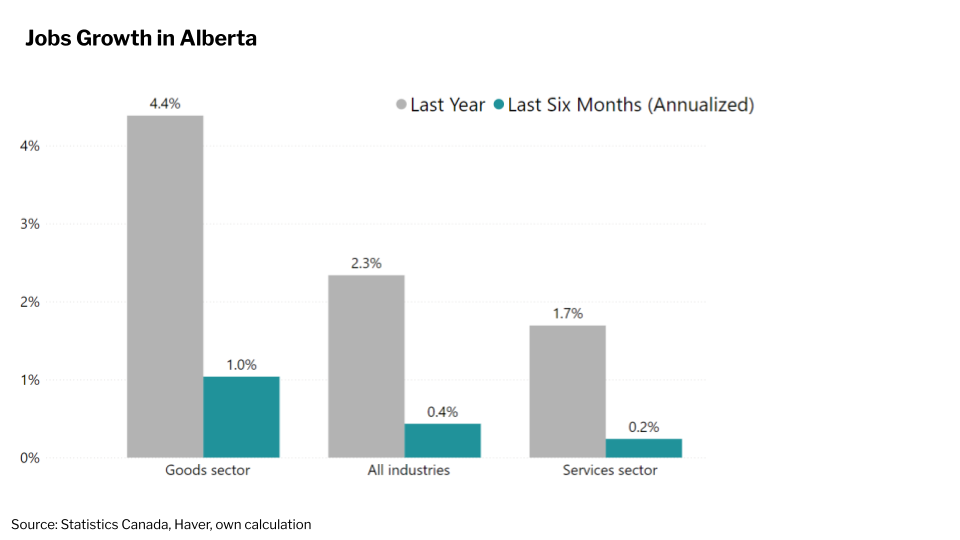
Alberta continues to churn out new jobs at a faster rate than almost anywhere else in the country – adding 13k jobs this past month, accounting for 90% of Canadian job gains. Nevertheless, its ability to do so is waning. Over the last quarter, job creation was just a fraction of levels seen over the last year. The slowdown is especially notable in the goods-producing sector and the oil and gas industry. Though both continue to post jobs gains in recent months, the pace of growth—at less than 1% (annualized)—is slow.

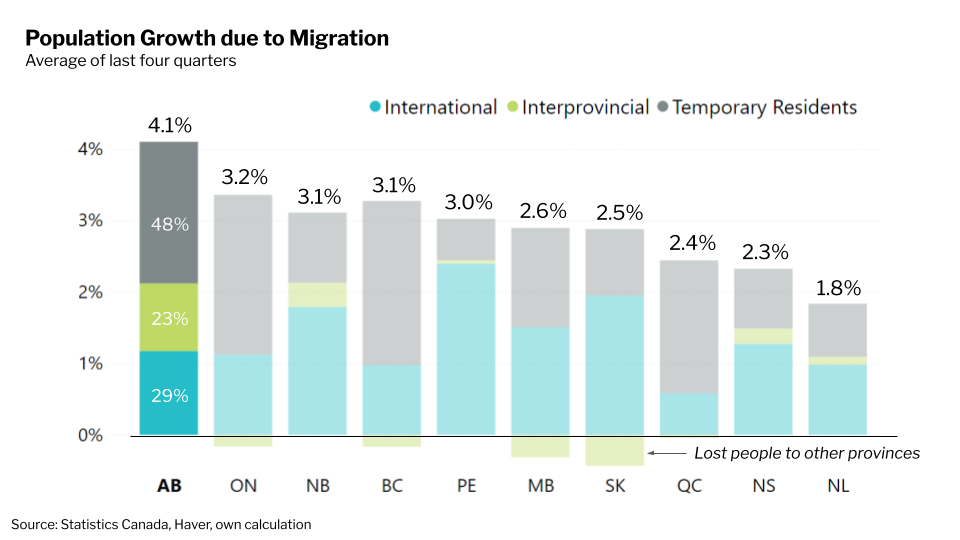
A growing population continues to be the province’s biggest driver of economic growth.
A surge in temporary residents accounted for almost half of Alberta’s recent 4.1% growth rate. However, what sets Alberta apart from other provinces is the influx of new residents from elsewhere in Canada (23% of total population growth). Looking ahead, population growth from migration is likely to stall with the new, much lower targets for immigration recently set by the federal government.

Canada seems set to avoid a recession.
Inflation is down significantly—at 1.6% as of the latest data, paving the way for additional interest rate cuts by the Bank of Canada. Canadian exports picked up in the third quarter largely thanks to the new capacity brought online by the Trans Mountain Expansion, offsetting weakness in the auto industry. Though output and employment in Alberta’s oil and gas industry are up, the outlook is for softer prices ahead. Slowing jobs creation, weak consumer demand, lower energy prices, and real-time indicators of economic activity (especially in Calgary) all point to weakness in Alberta’s economy. However, new home construction is a bright spot. In recent months, the industry is building at a pace of around 50,000 new housing units a year, compared with just 36,000 last year. Given Alberta’s enormous population growth over the last two years, this is important to support housing affordability and availability.


Growth expectations remain weak but steady.
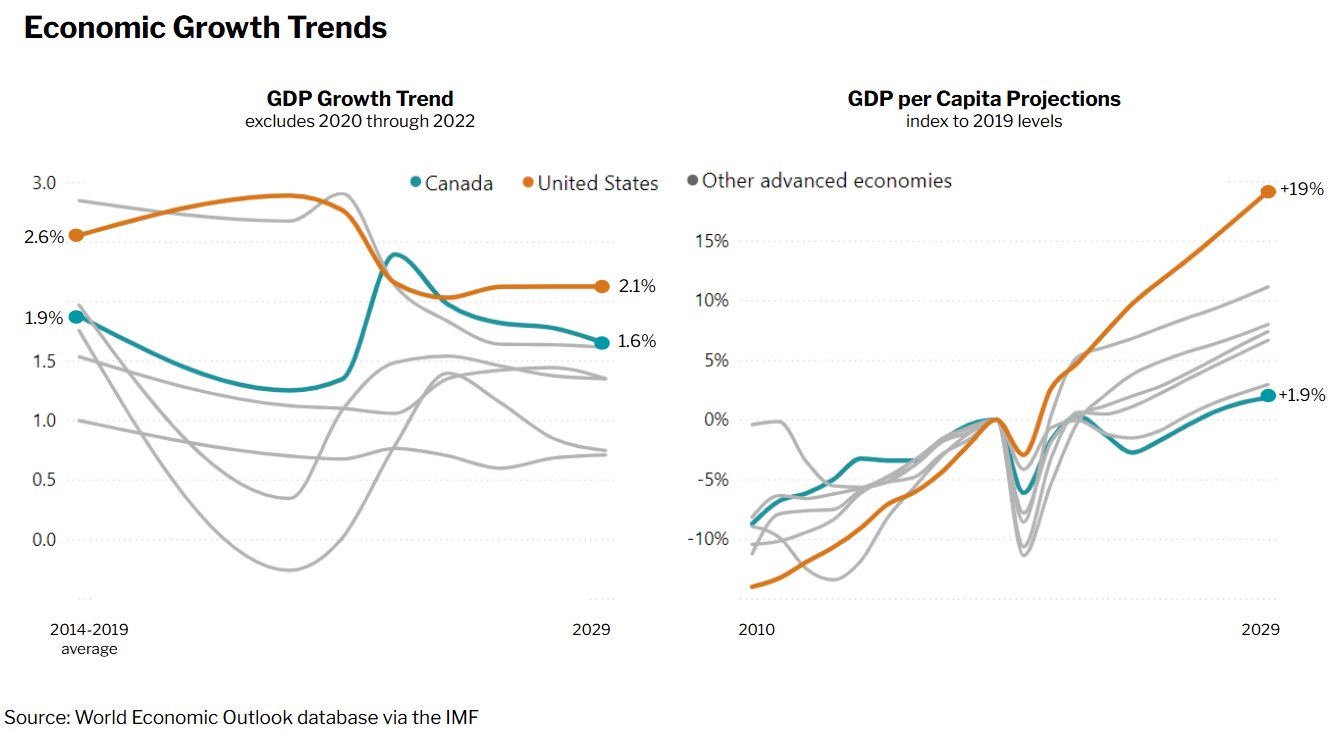
The global economy is expected to grow 3.2% over the next couple of years, buoyed by the US which, while slowing, is proving more resilient than expected. That said, this is the weakest global economic growth seen in decades. Moreover, even that growth rate has risks, notably escalating conflict in the Middle East—which could spell volatility for commodity markets—and a shift to greater protectionism in the world’s biggest economies (particularly in the U.S.). Notably for Canada, the US economy is expected to outpace our own by a considerable margin.

Albertans’ finances are OK, but they are worried for the province’s economic future.
Most Albertans report that their finances are still in a good (or at least okay) state. However, a growing portion (nearly 40%) are worried about the economy. Also of note, other polling data has found that Albertans are among the most worried about job losses from a slowing economy, suggesting that the rising unemployment rate is a real concern even among those currently working. Meanwhile, as mentioned, Alberta employers are among the least likely to report concerns about labour shortages as weakening demand becomes a bigger issue for future growth.

If you would like to use this report in a publication, please use the following citation.
Business Council of Alberta. Winter 2024.
Alberta Snapshot: A Quarterly Economic Update for Alberta.
Background:
We know there is so much economic data and information out there, and that you want a way to see it all in a snapshot with a view looking forward and not just back. That’s why we created the Alberta Snapshot, a quarterly executive summary that helps you keep the pulse on what is happening in Alberta’s economy—the good, bad, and urgent.
We use a wide and diverse range of indicators including data on jobs, consumer spending and debt, business openings and closings, population growth, economic forecasts, and more to assess and synthesize economic activity, business conditions, and social well-being in a way that is meaningful to Albertans and Alberta businesses.
Have an indicator you want us to look into? Email us at media@businesscouncilab.com.