




The Global Liveability Index by the Economist Intelligence Unit ranks cities around the world each year based on various factors to measure “liveability”. This year’s ranking brought some unwelcome news for Canada: three of the four Canadian cities included in the ranking fell from their previous spots. Calgary saw the biggest decline of any city on the list—dropping from 5th to 18th—while Toronto also had one of the biggest drops worldwide.
What’s the main reason cited for the decline? Healthcare. Long wait times and capacity issues brought down scores across the board. But other factors beyond those mentioned in The Economist’s ranking analysis are likely at play as well—persistent housing shortages, public safety concerns, and a growing strain on infrastructure and other public services have taken their toll on Canada’s city-dwellers in recent years.
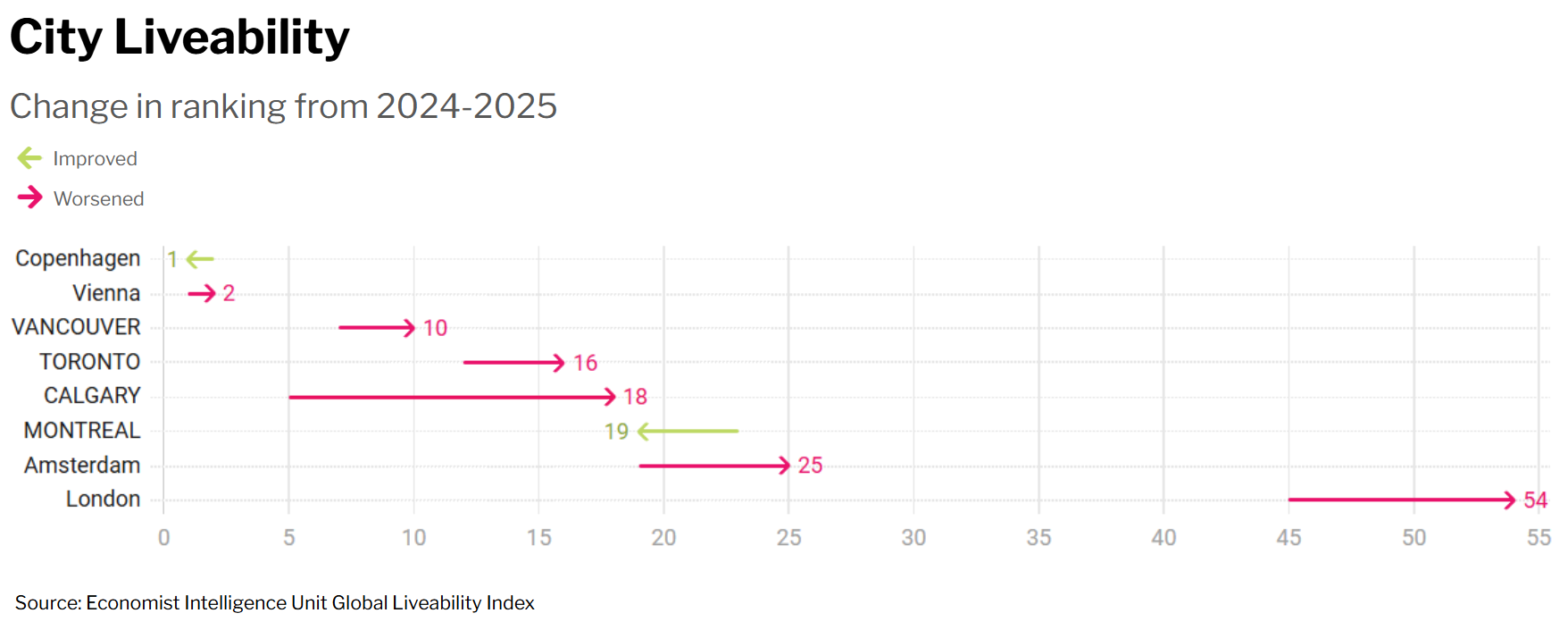
Some of this decline is expected, and is likely temporary. Canada has seen rapid population growth in recent years. When cities grow unusually quickly, existing resources are inevitably strained, at least in the short term. More people means more traffic, increased pressure on hospitals, and higher demand for housing. That may also explain why Montreal—the one major Canadian city with limited population growth—is the only one that didn’t fall in the rankings.
For what it’s worth, Canada wasn’t alone in this trend. Of the ten cities that fell the most in the rankings, half were in Canada and the UK—another country experiencing rapid population growth in recent years. Although in the case of the UK, its decline was primarily attributed to unique issues of social unrest and riots in the past year.
In spite of their lower ranks, Canadian cities are still good places to live. The four covered in the report all rank in the top 20 worldwide. And most residents of Calgary, Toronto, and Vancouver would likely say their city feels just as liveable as it did a year ago.
On top of that, any ranking system like this is unavoidably subjective. No methodology can ever fully capture everything residents care about, or how much they care about it. For instance, Vancouver stayed in the top ten despite having higher crime, more visible signs of street-level disorder, and far more expensive housing than Calgary which, as mentioned, dropped to 18th. Those impacted by crime or who cannot afford a home in Vancouver might disagree.
Still, these findings shouldn’t be brushed aside. If Canada wants its cities to be among the best in the world, it will need to get serious about the basics: expanding healthcare capacity, building more housing, improving public safety, and investing in infrastructure that meets the needs of the population. Global rankings aren’t everything, and these declines aren’t cause for panic, but they should be a wake-up call.