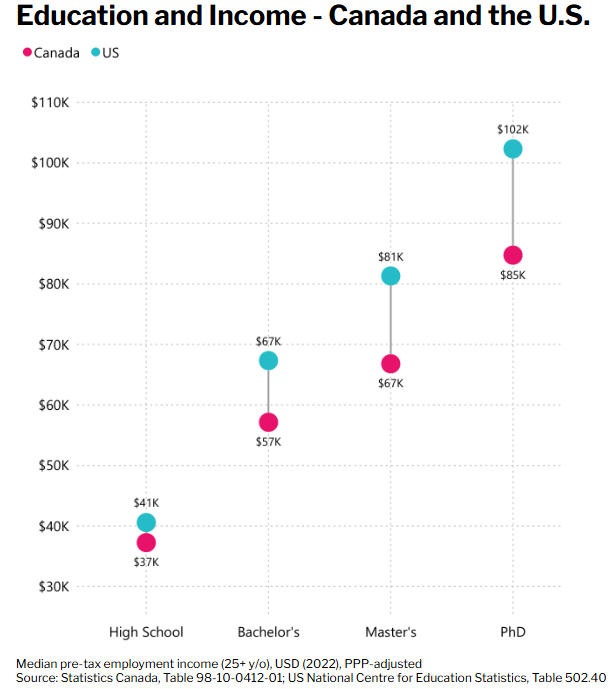


We often hear about how Canada is falling behind the U.S. on things like economic growth and productivity. But what does this mean for the typical Canadian?
Less money. Canadians earn significantly less than Americans, even when they have the same amount of schooling.
Based on the latest data, Canadians over age 25 with a bachelor’s degree typically earn around $57,000 (USD), while Americans with the same qualification make over $67,000. In fact, Americans only have to go to school for two years to earn close to what Canadians would pull in with a four year degree: Americans with 2-year associate’s degrees earn almost $50,000.
Things don’t look better at higher levels of education either. Canadians with master’s degrees fail to outearn Americans with bachelor’s degrees. So technically, it may be a better investment for a Canadian to pursue immigration to the U.S. rather than a master’s degree in Canada. Similarly, all the work of getting a PhD earns a Canadian only $3,500 more each year than an American with a master’s degree.
It’s worth noting that this income gap isn’t due to Americans pursuing more lucrative majors—there isn’t much difference between what students in the US and Canada end up studying. So, what is going on?
In a word: productivity. Individual workers in the U.S. are generating more economic value than their Canadian counterparts either because they are more highly skilled, or have access to better software, equipment, and other tools—known as capital investment—that support their productivity.
The fact that the earnings gap between Canadians and Americans exists across all education levels suggests that businesses in the U.S. are playing a bigger role in perhaps both training and capital investment. As such, increasing the return on education in Canada may not be about the education itself, but rather strengthening the Canadian economy in ways that encourage business investment which could benefit all Canadians—graduates and non-graduates alike.