




In a country as vast as Canada, affordable travel is critical for business, tourism and staying connected with friends and family. But as it stands today, travelling within our own borders is far too expensive.
To improve connectivity within Canada, the federal government is exploring the development of a high-speed rail network between Quebec City and Toronto. And in Alberta, the provincial government is developing a 15-year passenger rail plan that includes potential high-speed connections between Calgary and Banff, and Calgary and Edmonton.
Passenger rail can be a great travel option. It works well in countries that are relatively small and densely populated. Here in Canada, it has potential in specific pockets of the country, and many Canadians are envious of the comprehensive rail network that’s been built up over time in places like Europe and Japan.
But on a national scale, there’s a better option: air travel. That’s because it’s cheaper, faster, and more regionally equitable in a country as vast as Canada. And affordability and connectivity can be improved almost immediately nationwide with just a few policy decisions.
Let’s start with cost. Building a high-speed rail line between just Quebec City and Toronto was estimated by Transport Canada to cost $80 billion. Other estimates have the price tag closer to $120 billion. And that’s just for 800 kilometres serving one specific part of the country—imagine the cost of a 4,500-kilometre line through the Canadian Shield and Rocky Mountains.
That price tag comes in large part from the physical requirements of rail travel: an unbroken path of land, steel, and concrete from end to end. Rail infrastructure is resource-intensive and fixed in place. By contrast, air travel has a lot more reach with far less land and material needed—building two miles of rail track takes you two miles, but two miles of runway takes you around the world.
And we already have the airports and runways in place—no massive infrastructure buildouts needed. Instead of waiting decades to build thousands of kilometres of rail lines costing hundreds of billions of dollars, service could be expanded immediately with the only significant expense being airline companies buying new planes.
Not only that, but aside from relatively short-haul distances like Calgary to Edmonton or Toronto to Ottawa/Montreal, air travel gets people to where they’re going much faster. Even at top speeds of 300 km/h, getting from Toronto to Calgary on a high-speed train would take 11 hours—assuming it would be going that fast the whole time and have no stops.
It’s just 4.5 hours if you fly, though. That’s one of the reasons we can’t directly compare Europe with Canada. Europe’s world-class rail system works in part because it serves a much smaller area—the distance between Toronto and Calgary is almost double the distance between London and Rome.
And speaking of geography, rail (even conventional passenger service) can only practically serve people in major cities—and perhaps some folks in the towns in between. Airports, though, already exist across the whole country. They’re in small towns, and rural and remote communities. And they’re not just sitting empty—for example, more than one third of the airports WestJet flies to are in areas with populations of less than 100,000.
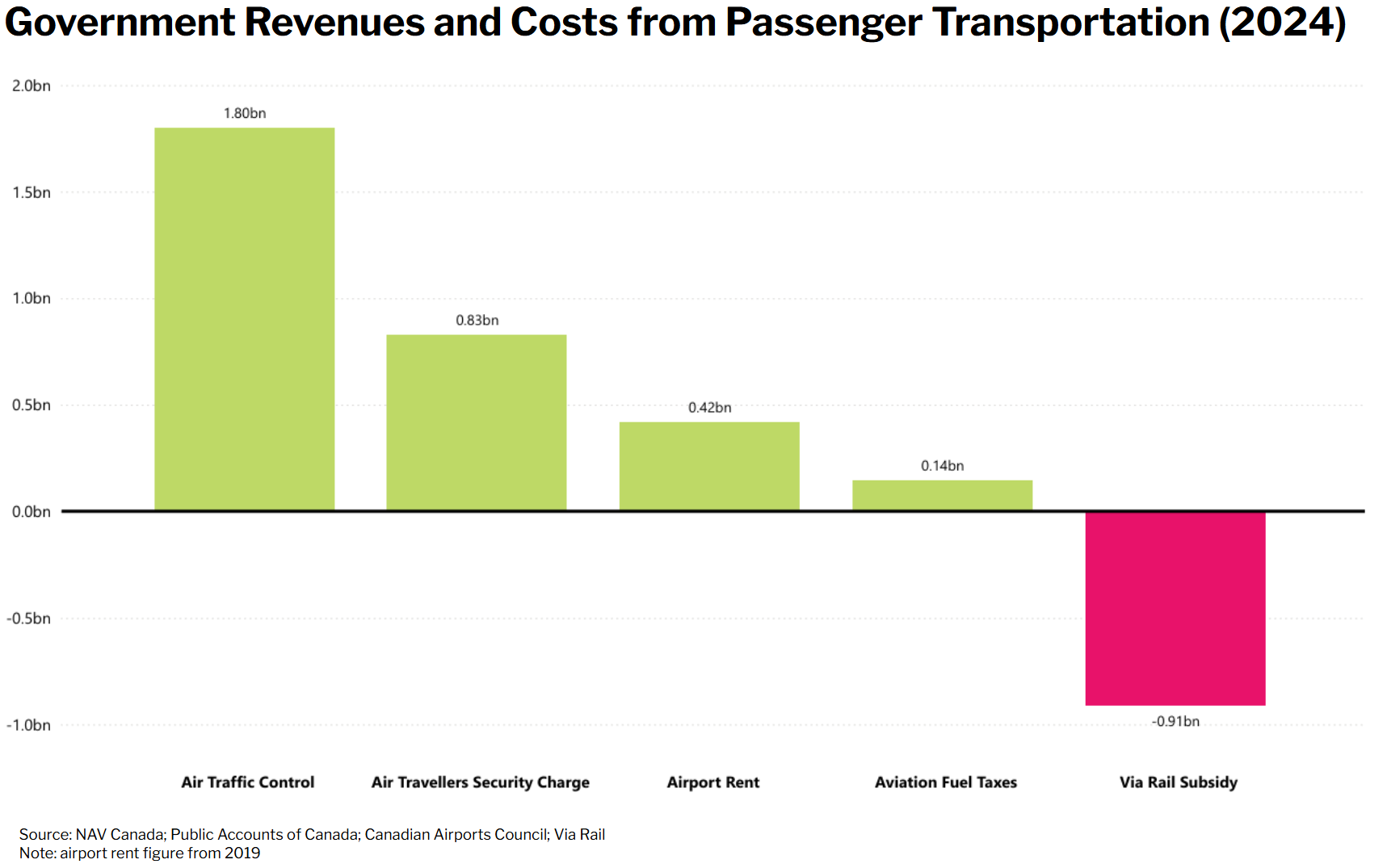
Finally, the passenger rail we currently have is heavily reliant on public funding. Via Rail benefits from hundreds of millions of dollars in subsidies and wouldn’t be able to stay afloat without them. In 2024 alone, Via Rail received $912 million from the federal government—that works out to $88 per passenger—and posted an operating loss of $385 million.
And that’s just the subsidies for the operating costs. The infrastructure—rail tracks and train stations—also receive public funding. Once you include all of that, the total amount is far higher.
That doesn’t mean the proposed new rail projects won’t be financially viable (after the infrastructure is built). But air travel doesn’t receive, or require, any public funding.
In fact, it’s the opposite. The federal government treats air travel as a cash cow, charging a wide array of taxes and fees that directly and indirectly increase the price of your ticket.
That’s how we can make air travel more affordable: by bringing Canada’s air travel fees more in line with other countries. That would immediately lower the cost of air travel, increase demand, and lead to expanded service nationwide.
People often blame airlines for high ticket costs, but flying is actually far cheaper than it used to be—the base fare for domestic air travel today is almost half what it was in 1995. What’s changed is the number and size of fees charged by the federal government. Fees are 65% higher today than they were in 1995. They used to account for one tenth the cost of a ticket. Now, they’re a full quarter of what you pay.
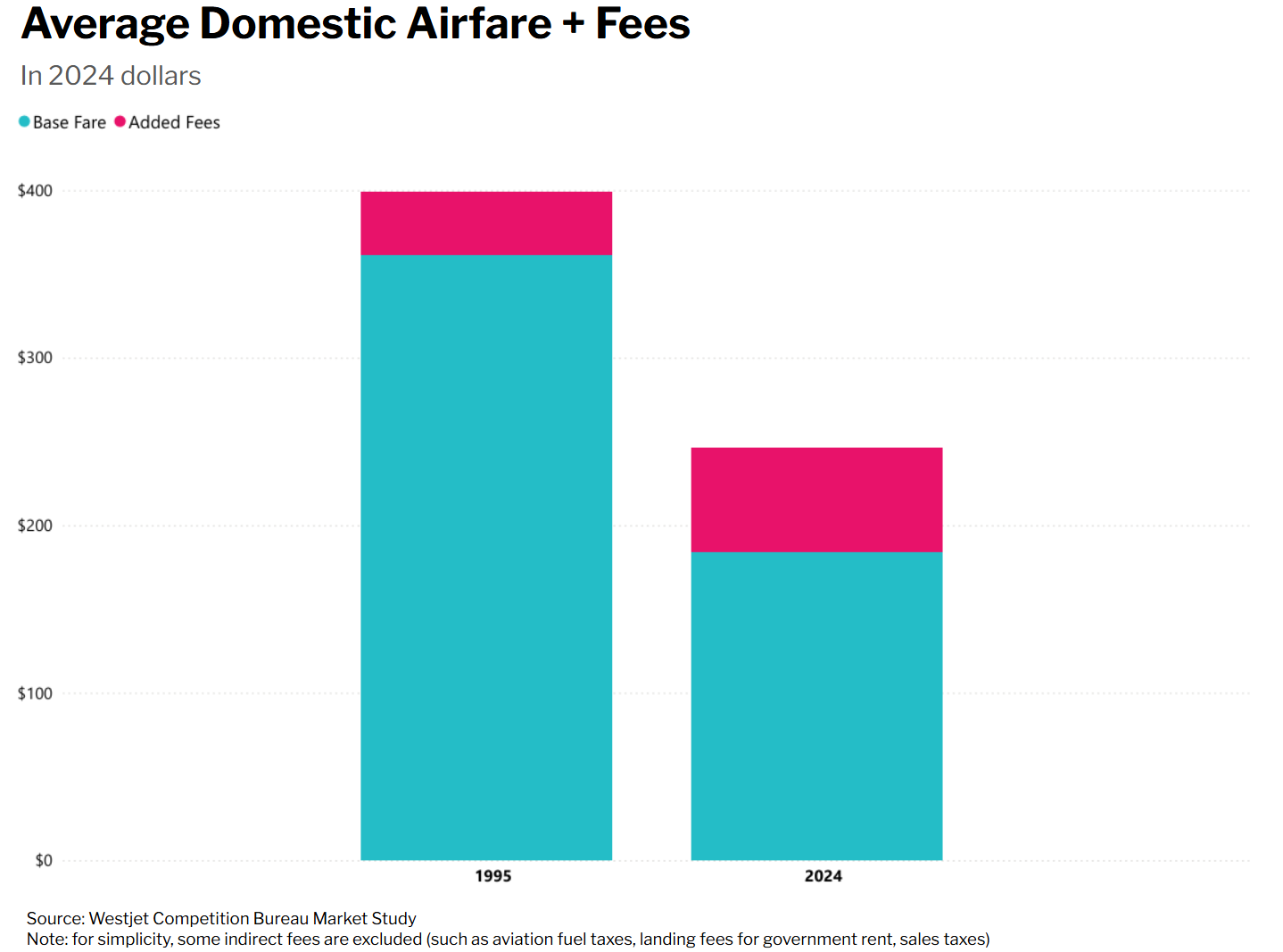
Here’s a breakdown of the typical fees and what they cost you:
- Directly charged to passengers:
- Airport Improvement Fees – $34 (not including GST)
- Air Travellers Security Charge – average of $13 per trip (not including GST)
- Indirectly charged to passenger:
- NAV Canada Fees (Air Traffic Control) – $16
- Aviation Fuel Taxes – $3
- Airport Rent (via Airport Landing Fees and Terminal Charges) – $7
These add up to about $75 per one-way ticket.
To put that into perspective, you can buy a basic one-way WestJet flight from Vancouver to Toronto for about $205 for most of this summer (at the time of writing this). If you removed all those fees, the ticket price would drop to just $130.
These fees and taxes hit short-haul flights disproportionately hard because most are fixed charges and aren’t affected by how far you’re going. At the time of writing this, a basic Calgary–Vancouver flight this summer costs just $50 for the base fare (even including the indirect fees), but you’ll pay double that once the direct charges are applied.
Every country applies taxes and fees on air travel, but Canada is an outlier in terms of how far they go. Australia and the United States charge about half as much as we do and they have lower ticket prices to show for it.
It’s no wonder so many Canadians living near the border fly from US airports instead. There are even airports in the US where the majority of passengers are Canadian. What’s more, US airlines have reduced services to and from Canada because of high fees, especially to and from smaller airports.
Of course, many of these fees support vital aspects of flying, like security and air traffic control. But it’s worth putting these costs into perspective; the money spent on the (conservatively) estimated $80b high-speed rail project between Quebec City and Toronto is enough to cover the annual revenues generated from:
- NAV Canada Fees (Air Traffic Control) – $1.8 billion (2024);
- Air Travellers Security Charge – $827 million (2024);
- Airport Rent – $419 million (2019); and
- Aviation Fuel Taxes – $142 million (2024)
for a full 20 years. After that, there’d still be a lot left over to make a dent in airport improvement fees over that period, too.
If Canada could even just halve the costs of fees added onto plane tickets—bringing them in line with fees in other countries—it would stimulate demand for an additional 12 million one-way domestic flight boardings per year, never mind the impact on international travel. That’s enough to sustain another airline the size of WestJet—increasing competition in the domestic market. And the cheaper flights would benefit all Canadians, not just those living in one region.
Passenger rail can be an attractive travel option in some parts of Canada. But if we want to truly make nationwide travel more affordable and accessible, a simple, cheap and immediate solution is to cut the cost of air travel.