




A university education is often seen as the most reliable path to a successful, financially rewarding career. While there’s some truth to this, it’s also true that we tend to overlook equally valuable—and increasingly essential—career paths in the skilled trades.
Canada and Alberta are facing a shortage of all kinds of tradespeople—from welders to electricians to heavy equipment mechanics—especially in areas of construction, manufacturing, repair, and maintenance.
Our recent report, Laying the Foundation: Solving Labour Supply in the Skilled Trades contains many recommendations for how to address this shortage. But one of the simplest is to better communicate the earnings potential and financial advantages of working in the trades.
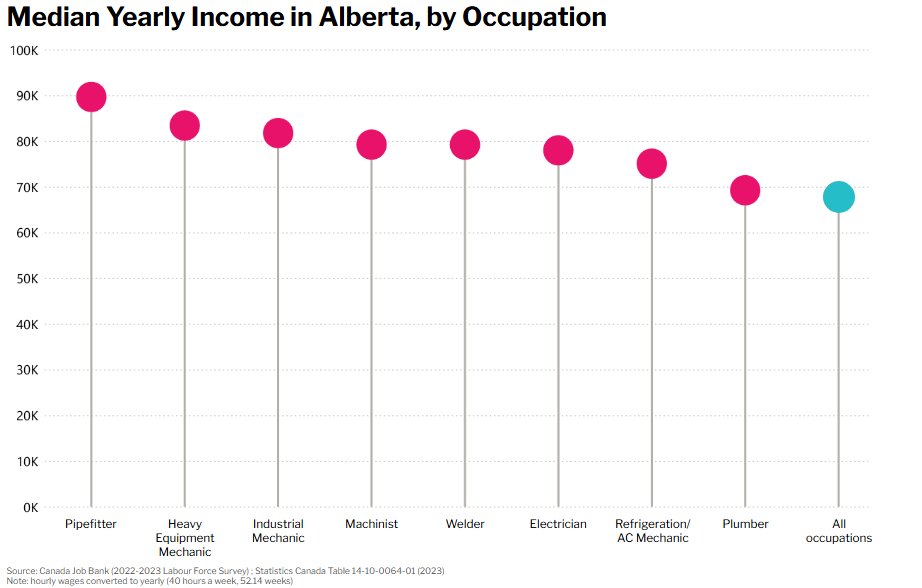
Skilled tradespeople often earn an income rivaling that of university graduates. The median income of most skilled tradespeople in Alberta hovers around $80,000 a year, ranging from around $70,000 for plumbers to nearly $90,000 for pipefitters (assuming a 40-hour workweek). For comparison, accountants and primary school teachers in Alberta can expect to make around $82,000. But to enter those professions also requires at least four years of education, as well as the high cost of tuition and lost earnings along the way.
Students in the skilled trades, on the other hand, usually have little to no debt when they complete their programs. In part, that’s because they make money during the apprenticeship portion of their education—earning at least 50% of a journeyperson’s wage in the first year and 80% or more by the final year. So, straight out of high school, an electrician’s apprentice can earn $39,000 in their first year. And by the time their peers in universities are graduating, tradespeople will have 4 years of work experience and be earning a full journeyperson wage.
Of course, money isn’t everything when it comes to career choice, and the skilled trades won’t be the right fit for everyone. But the typical skilled tradesperson likely makes far more than people realize. For someone potentially interested in a trades career, it’s nice to know that going to university isn’t the only pathway to a successful, financially rewarding career.
Have an indicator you want us to look into? Email us at media@businesscouncilab.com.