




Free trade leads to a lot of good things: from lower prices and more selection for consumers to higher incomes for Canadians. In fact, it’s estimated that incomes are 15 to 40% higher as a result.
But recent policy developments suggest free trade is out of style.
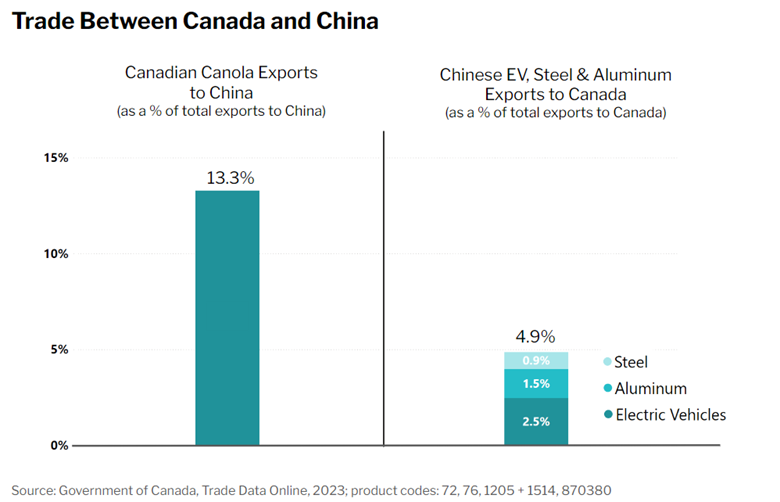
In case you missed it, Canada recently announced new tariffs on imports of certain Chinese-made products including a 100% tariff on electric vehicles as well as a 25% tariff on steel and aluminum.
The rationale for this action is that it’s viewed as necessary to protect a small but growing EV industry in North America. But there’s also added pressure from the US and EU who have already imposed similar tariffs on the grounds that unfair practices are propping up production in China.
Almost immediately, China clapped back with an investigation into canola imports from Canada. So far, no barriers have been put up. But it has nonetheless put Canadian farmers on high alert with the prospect of a classic tit-for-tat trade war.
This would be costly.
The exact cost to Canadian producers will depend on the size of the tariff (or other trade barrier of choice) and how much it deters consumers (do some Chinese customers continue to buy from Canadian farmers despite higher prices?).
Nonetheless, the size of the industry suggests the hit to Canada’s economy would be meaningful. Canola is one of Canada’s biggest exports to China, amounting to $4 billion dollars annually or around 13% of exports to the country. In fact, in terms of the value exported between the two countries, the canola industry is more important to Canada than EV sales are to China. This commodity wasn’t selected at random.
But there are other cost implications as well. One is the regional impact. As some have pointed out, while the benefits on the EV sector will be concentrated in Ontario, the costs of a potential barrier on canola would be concentrated in the Prairies.
Another is the cost to consumers. Tariffs on China help Canadian producers but hurt Canadian consumers. Some of the most affordable EVs are produced in China. In their absence, consumers will be left with fewer options and higher prices for EVs. This is especially important given that all new cars sold in Canada are expected to be zero-emission by 2035.
Whether a given decision to restrict trade is the right move likely comes down to politics over economics. Nonetheless, rising tensions and the recent chain of events show decisions to restrict trade—however well-reasoned—rarely come without consequence. And these decisions should not be taken lightly.
Have an indicator you want us to look into? Email us at media@businesscouncilab.com.