

Recently, Greece introduced a 6-day work week in an attempt to promote economic growth, taking their 40-hour work week to 48.
Though not as dire as Greece’s, Canada’s per capita economic growth has been weak for decades and, more recently, has declined.
Should Canada consider something similar to Greece’s longer work week?
Technically, such a policy would increase GDP per capita—a common measure of economic prosperity. Working more hours creates more economic value meaning higher incomes for individuals and more tax dollars for governments.
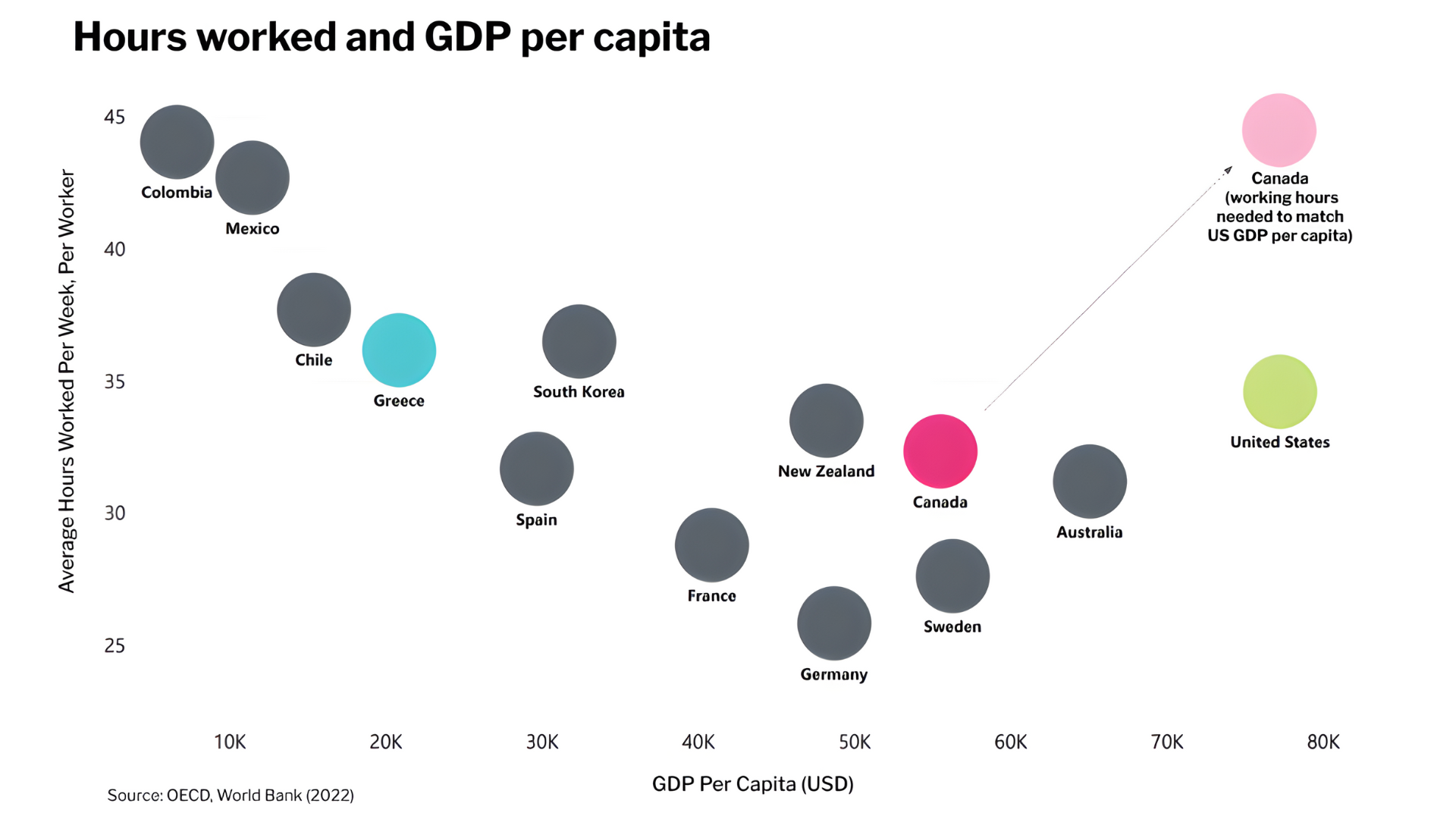
But countries that work more hours aren’t necessarily more prosperous. In fact, the relationship is usually the opposite. For example, Greeks already work more than anyone else in the EU yet the country has one of the lowest levels of GDP per capita in the region.
That is because there are three factors that determine economic prosperity: hours worked, employment, and productivity. While all play a role, productivity, not hours worked (nor employment), is what separates rich countries from poor ones.
Importantly, productivity is the only factor that generates more economic value without more work. People in rich countries tend to work less, not more, largely because they can.
Let’s compare Canada and the US. Right now, per capita GDP in Canada is sitting at 65% of US levels. If Canadians were to simply work longer hours to match the US’s GDP per capita, it would come at the cost of 13 hours of leisure time a week, increasing average hours worked from 32 to 45. Meanwhile, Americans work 3 hours more than Canadians but, thanks to a productivity advantage, generate a GDP per capita that’s 40% higher.
Other examples further illustrate the importance of productivity. Germany has a comparable GDP per capita to Canada, but Germans work six fewer hours per week. Meanwhile, Swedish workers clock an average of just 28 hours a week but have a slightly higher GDP per capita than Canada.
Greece’s policy of increasing working hours could yield modest gains in economic growth but is ultimately misguided. It comes at a high cost of leisure time and with a risk of worsening an already bad situation (e.g., if it encourages young people to leave). The choice of whether to work harder or smarter—to work more hours per week, or to get more out of each hour—while not easy, is obvious.
Have an indicator you want us to look into? Email us at media@businesscouncilab.com.