




On October 19, Albertans will have the opportunity to vote on whether the province should pursue a binding referendum to leave Canada.
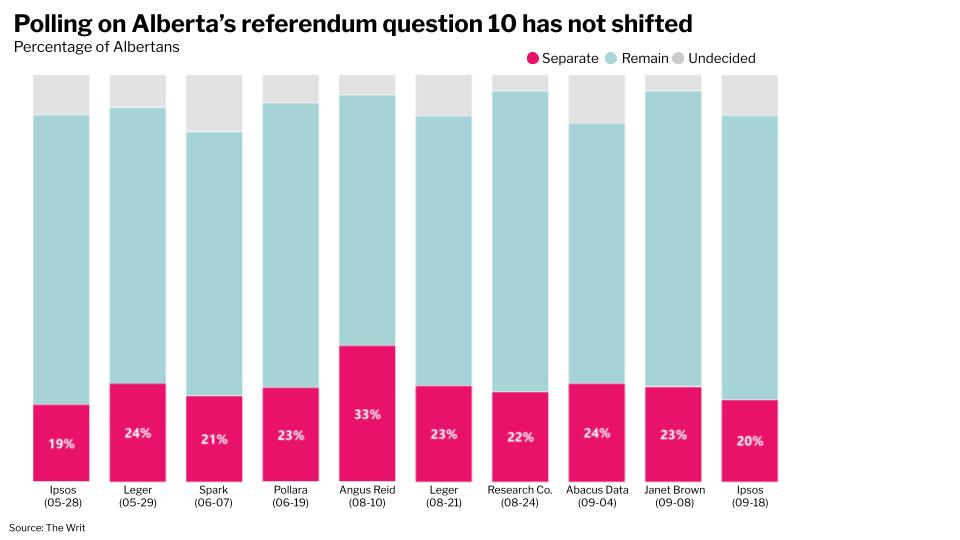
Polling data suggests a “leave” outcome is unlikely. The latest polls show that around 20-25% of voters support launching the process for a binding separation referendum — which is Option 2 on the ballot — while around 65-70% support remaining in Canada. The numbers haven’t meaningfully budged since polling began.
For what it’s worth, prediction markets agree. Platforms like Polymarket and Kalshi are bullish that Albertans will vote to remain in Canada.
Still, there’s no way to know for sure until the votes are counted. A few similar referenda in recent-ish history show that results can sometimes surprise both pollsters and prediction markets.
Take the 1995 Quebec sovereignty referendum. More Quebecers ended up voting to stay in Canada than expected — enough to flip the result from a projected win for leaving (53% in pre-vote polling) to a narrow win for staying (51%).
Brexit went the other way. Far more people turned out to vote to leave the EU than earlier polling had expected. As in Quebec, the race was tight enough that the modest difference between the opinion polls and the final result — a 52% vote to leave the EU — was enough to produce a different outcome than what the polls had suggested.
Further, recent U.S. presidential elections, while not votes on sovereignty or independence, have brought similar surprises. State-level polls in key battleground states consistently underestimated support for Donald Trump in 2016, and yet again in 2024.
There are two factors driving these discrepancies, either or both of which could also play out in the Alberta referendum: polling error and voter turnout.
Here’s what each could mean for October 19.
First: polling error. Polling is not an exact science. Pollsters’ goal is to capture a random sample of individuals that accurately reflect the overall voter base. But ultimately, whether that sample is truly representative depends on three things: being able to contact a broad cross-section of voters despite the increased use of mobile phones and unlisted numbers; people’s willingness to answer a phone call or fill in a survey; and, if they do, whether they answer questions honestly.
Some people and groups are easier to reach and more willing to share than others. In both Brexit and the 2016 U.S. presidential election, voters with lower levels of institutional education, who leaned heavily toward Leave and Trump, were typically less likely to participate in surveys. Since most pollsters weren’t yet adjusting their results to account for these differences in response rates, they underestimated a group who were central to the result of both votes.
A similar issue could be at play in Alberta. Survey data suggests that Albertans without a university degree are more than twice as likely to vote for Option 2 compared to those with. Depending on how effectively pollsters are ensuring representative samples, there’s potential that support for Alberta separation may be understated in some polling.
Getting honest answers from respondents also matters. Research has found that people are generally less willing to divulge their true opinions on sensitive topics, especially if those opinions are controversial, stigmatized, or seen as socially unacceptable. This may have played out in Brexit where polls conducted with greater anonymity online accurately showed more support for leaving the EU compared to those conducted over the phone where respondents had to disclose their views to another person.
It’s unclear if or how much this is an issue in Alberta. But there’s an additional wrinkle to the province’s upcoming referendum. Some Albertans will vote for Option 2 not because they want to leave Canada but because they think doing so will create leverage with the federal government, or ultimately “send a message” to Ottawa. That fact muddies the water when it comes to estimating the true number of Albertans who actually and truly want to separate. A recent focus group described the “typical Albertan” with that tension in mind: an individual who doesn’t support separatism but is tempted by the leverage such a vote could offer.
The other major factor is voter turnout. If some folks are more likely to get out and vote than others, a poll may accurately represent the views of the general population but not the outcome of the vote.
This factor was especially notable in Brexit. Those who wanted to leave the EU were more likely to show up to vote, with turnout unexpectedly high in Leave-leaning areas. Effectively, among those who don’t always vote, those who did show up were the ones that were more mobilized in support of leaving the EU.
Of course, in Alberta’s case, polling data points much more decisively towards a decision to remain in Canada. Nonetheless, a similar pattern to the Brexit result could play out if those intending to vote for Option 2 are more mobilized and motivated. Some separatists “will crawl across broken glass to make their vote count”, says Thomas Lukaszuk, leader of the Forever Canadian petition. Meanwhile, folks on the other side may be less likely to take the time to vote if they assume the outcome isn’t in doubt.
Robson Fletcher’s referendum simulator shows just how much the referendum results could shift depending on how lopsided voter turnout is. As a starting point, a weighted average of poll results suggests that about 24% of Albertans support Option 2. If this is accurate, then Option 2 would prevail in the referendum only if 92% of its supporters turned out to vote, compared to 29% of those favouring Option 1. In other words, an Option 2 victory would require nearly unheard-of voter turnout rates from its supporters and an apathetic showing from those wanting to remain in Canada.
If one is to believe the polling done to date, the October 19 referendum is unlikely to result in a win for Alberta separatists, but as Quebec, Brexit and the U.S. all show, there are no forgone conclusions on public referenda. The final result will depend on who turns out to vote, and the decisions made by those who are tempted to “send a message” to Ottawa.
For its part, the Business Council of Alberta supports a strong Alberta in a united Canada. But regardless of their stance, we encourage every Albertan to get out and vote on October 19, because the only bad outcome for a democratic vote is one where turnout was too low to reflect the will of the people.
Have an idea for our next EconMinute? Email us at media@businesscouncilab.com.