




Canada has been promising to cut red tape for decades, but the web of regulations has only grown. Since 2006, the total number of federal regulations climbed by 37%, despite a series of initiatives meant to do the exact opposite.
From Prime Minister Harper’s Red Tape Reduction Action Plan to Prime Minister Trudeau’s Targeted Regulatory Reviews (which are still ongoing) to Prime Minister Carney’s Red Tape Review, successive governments have all had their “red tape moment.” Yet it’s hard to find any proof in the pudding.
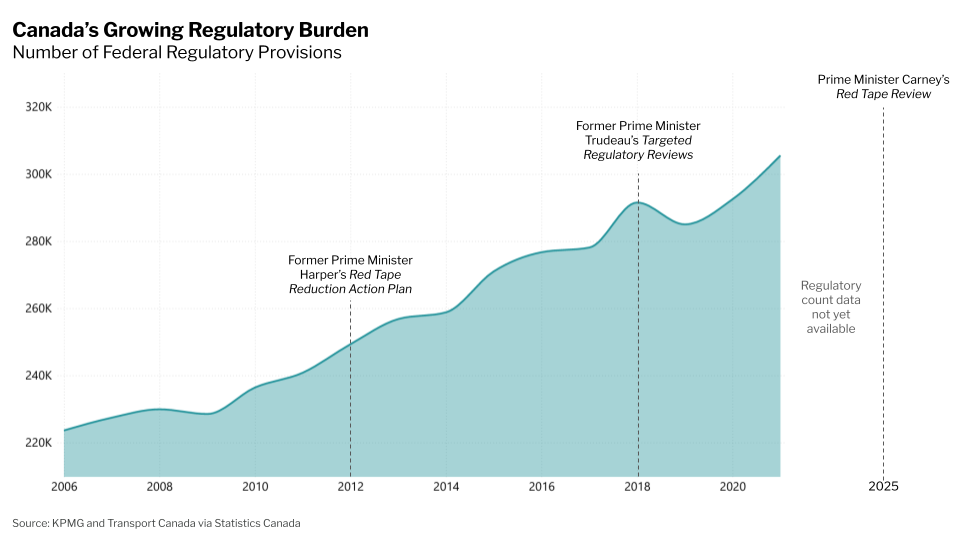
According to data from the Mercatus Center, which tracks the volume and complexity of federal regulations in the U.S. and Canada, Canada’s regulatory load hasn’t just risen; it grew almost twice as fast as in the U.S. over the most recent five years of available data (2016–2021).
It hasn’t gotten any less complicated either. The same dataset shows that many sentences in federal regulations blow past the Treasury Board’s plain-language guideline of 20 words, with some running more than twice that. And despite the goal of making regulations “accessible and understandable,” lawyers and regulatory experts are often needed to make sense of them.
The only real sign of progress comes from the government’s own carefully-chosen success metric. The 2012 One-for-One Rule requires that any new regulation which imposes an administrative cost (things like filling out forms or reporting information) on businesses be offset by a reduction elsewhere. Even with the potential bias of measuring its own success, Ottawa was able to show only a very modest reduction in the administrative burden of compliance since 2012.
But that rule only captures about 20% of regulations on the books. The remaining 80% may not involve more paperwork, but they’re hardly cost-free. And even for the 20% that do, administrative tasks are rarely the biggest problem. Higher efficiency standards, industrial emissions caps, and new building codes can all have major implications on competitiveness, investment, and prosperity, whether or not they involve more paperwork.
As the Business Council of Alberta recently noted in The High Cost of Low Investment, Canada’s high and growing regulatory burden is an important factor behind our lagging record on business investment. Simply navigating such a regulatory behemoth is time-consuming, expensive, and diverts resources away from more productive activities. It also weakens the system itself; when outdated or ineffective regulations remain on the books, they can undermine the effectiveness of the rules that actually improve health, safety, and market performance.
The good news is Prime Minster Carney’s current initiative offers some hope. Along with the review, which asks all federal departments and agencies to look at their regulations for duplication, overlap, and inefficiencies, the government has also set up a Red Tape Reduction Office within the Treasury Board Secretariat to oversee the process and track progress.
But success will require more ambition and accountability. Without both, this effort risks being just another round of box-ticking and high-fiving without actual results.
Have an idea for our next EconMinute? Email us at media@businesscouncilab.com.